Bolts

Compare your fastener to our visual size guide to confirm size, pitch and length.
Match your spanner / socket AF (across-flats) to the size it fits - our reference chart covers every metric and imperial size we stock.
Bolts for Structural, Industrial and General Fastening
Bolts hold structural work together — from a single M5 hex bolt in a control panel to an M36 K0 structural assembly fastening steel beams. We stock 3,700+ bolt variants across nine subcategories, with same-day shipping on stocked lines from our Brisbane warehouse. Metric, UNC, UNF, BSW and BSF threads; classes from low-tensile 4.6 up to high-tensile 12.9; stainless A2-70 and A4-70 marine grade; galvanised, zinc, plain black and brass finishes.
Check our reviews from DIYers, tradespeople, builders, manufacturers, government, councils, engineers across Australia.
MATERIALS AND COATINGS
Choose by environment, required strength and finish.
Stainless Steel — Corrosion resistance for external and wet environments. A2-70 G304 for general use, A4-70 G316 for marine and coastal. largely non-magnetic.
Zinc Silver Plated — Bright silver finish, internal use only. Economical electroplated zinc, the default for protected environments.
Galvanised — Hot-dip galvanised carbon steel. Heavier coating than zinc plate; the right choice for outdoor and treated-timber work.
Zinc Yellow Plated — Yellow chromate finish. Used on Sems and select coach bolts.
Plain Black Uncoated — Bare uncoated carbon steel. Used on Grade 9 plow bolts and high-tensile hex bolts where the customer applies their own finish.
Brass — Corrosion resistant, non-sparking, decorative finish. Specialist applications in marine, plumbing and heritage work.
Nylon — Non-conductive, chemically resistant, lightweight. Specialist use in electronics and isolating assemblies.
CLASSES AND GRADES
Australian and international tensile grades stocked across the range.
High Tensile Class 8.8 — The workhorse high-tensile grade. Yield 640 MPa, ultimate 800 MPa. Most metric structural bolts.
High Tensile Class 10.9 — Higher yield (940 MPa, ultimate 1040 MPa). Demanding mechanical applications.
High Tensile Class 12.9 — Premium high tensile. Used on flange bolts where high clamp load is required in a compact head.
Low Tensile Class 4.6 — Economical mild-steel grade for general fastening where high strength isn't required. Coach bolts, coach screws, lower-load structural work.
A2-70 G304 Stainless Steel — The standard stainless grade. Suitable for most external Australian environments.
A4-70 G316 Marine Grade Stainless — For marine, coastal and chemical exposure. Use within 300 metres of the coast.
A4-80 G316 High Tensile Stainless — High-tensile variant of marine grade, comparable strength to Class 8.8 without sacrificing corrosion resistance.
Imperial Grades 5, 8 & 9 — High-tensile imperial classes for UNC/UNF/BSW threads. Grade 9 is the highest, found on plow bolts.
THREAD SYSTEMS
Five thread systems stocked across the bolt range.
Metric Coarse — The Australian default. M3 through M36.
Metric Fine — Fine-pitch metric, used in automotive and precision work.
Unified Coarse (UNC) — North American coarse imperial. Common in imported equipment and plant.
Unified Fine (UNF) — Fine-pitch imperial, similar applications to UNC where finer control of clamp is required.
BSW (British Standard Whitworth) and BSF (Fine) — Original British threads, still used in heritage, restoration and older Australian equipment.
Metric Left-Hand Thread — Reverse-thread metric coarse for applications where right-hand rotation would loosen the fastener.
UNDERSTANDING THREAD PITCH
Thread pitch (metric) is the distance between the peaks of two adjacent threads, expressed in millimetres. A thread pitch of 1.50mm means adjacent threads are 1.50mm apart. All our metric bolts use standard metric coarse pitch unless otherwise specified.
Imperial sizes are measured in TPI (threads per inch). To identify the TPI of an unknown bolt, measure 1" (25.4mm) along the threads with a ruler and count how many thread peaks fall within that span — that number is the TPI. On smaller bolts the threads can be hard to count by eye — use a pen or thin drill bit to step from one thread to the next as you count, and a torch (or your phone light) for better visibility.
HEAD STYLES
Five head styles across the range.
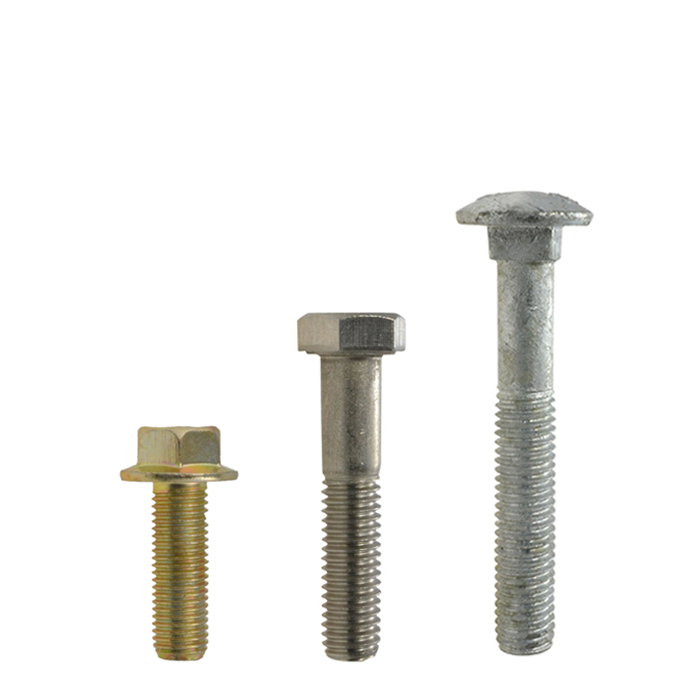
Hex Head — The standard six-sided head, driven with a spanner or socket. The default for general bolting.
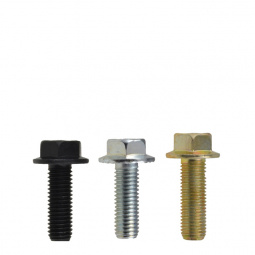
Hex Flange Head — Hex head with an integrated washer face. Distributes clamp load and removes the need for a separate washer.
Cup Head — Low-profile domed head with a square section underneath that locks against rotation in timber. Coach bolts only.
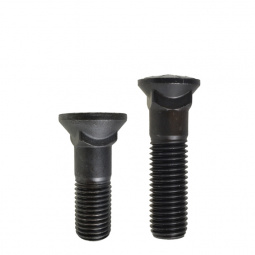
Raised Head (Plow) — Flush-mounted countersunk-style head used on plow bolts so cutting edges don't catch.
Countersunk Head — Flush-mounted tapered head used on select coach screws where appearance or clearance matters.
OUR RANGE
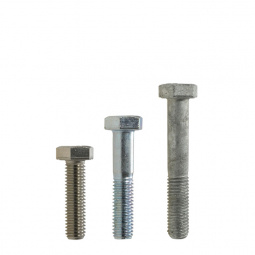
Hex Bolts & Set Screws — The workhorse of bolting — hex head, fully or partly threaded, in zinc, stainless, galvanised, brass and nylon, M3 to M30 and 1/4" to 1-1/2".
Hex Flange Bolts — Hexagon head with an integrated washer face under the head. Serrated variants resist loosening; popular in automotive and structural assembly.
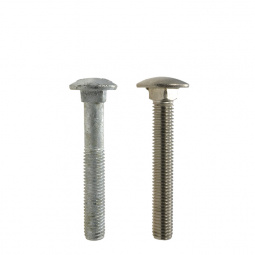
Cup Head Coach Bolts — Low-profile domed head with a square section under it that locks against rotation in timber. Used with a nut and washer to fix wood to wood or wood to steel.
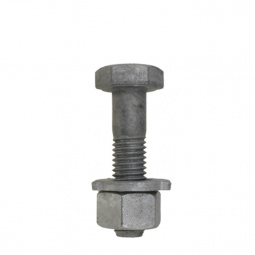
Structural K0 Bolts & Nuts — HSFG (High Strength Friction Grip) preassembled bolt, nut and washer sets to AS1252:2016 K0. Hot-dip galvanised Class 8.8 for steel-to-steel structural work.
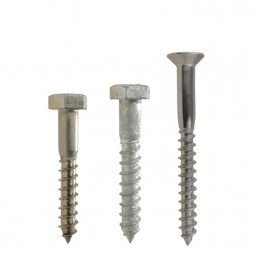
Coach Screws — Hex-head wood screws — drive straight into timber without a nut. Galvanised Class 4.6 and A4-70 G316 stainless, M6 to M16.
Plow Bolts — Grade 9 high-tensile bolts with a flush countersunk-style head and square neck. For attaching cutting edges to plows and earthmoving blades.
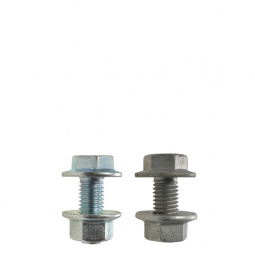
Sems — Bolts pre-assembled with a captive flat or spring washer under the head. Saves time and ensures the washer is never forgotten on the assembly line.
Left Hand Thread Hex Bolts & Set Screws — A2-70 G304 stainless hex bolts with reverse (left-hand) thread for applications where right-hand rotation would loosen the fastener — pedals, fans, cutting tools.
Purlin Flanged Bolts — Hex flange-head bolts to AS1110 for fastening purlins and girts in structural roof framing. Zinc plated Class 8.8 and galvanised Class 4.6.
FREQUENTLY ASKED QUESTIONS
Can stainless fasteners be used with aluminium?
Yes — and for most applications, no special precautions are needed. The combination is widely used in industries where strength and corrosion resistance matter (marine, automotive, structural aluminium). For applications with sustained moisture or salt exposure, a few simple steps (barrier washer, sealant, matched-anodising) prevent any long-term galvanic corrosion concerns. Full guidance: Can stainless fasteners be used with aluminium?
What is the difference between a hex bolt and a hex set screw?
A hex bolt has a plain unthreaded shank under the head with thread only on the lower portion of the shaft, while a hex set screw is fully threaded from head to tip. Both share the same hex head and spanner sizes, but a bolt is typically used where you want clamp without thread running through the joint, and a set screw is used where the entire engagement is threaded.
What does Class 8.8 mean on a bolt?
Class 8.8 is the most common high-tensile metric bolt grade. The first digit (8) indicates ultimate tensile strength in hundreds of MPa (so 800 MPa), and the second (.8) gives the ratio of yield strength to ultimate (yield = 640 MPa). Class 10.9 and Class 12.9 are stronger grades; Class 4.6 is a low-tensile grade for general fastening. Class 8.8 is the workhorse grade for structural steel, automotive engineering, industrial machinery, mining and heavy equipment applications.
When should I use galvanised vs stainless bolts?
Galvanised is the economical choice for outdoor work like timber framing, treated pine and external structural connections — the hot-dip zinc coating gives years of corrosion resistance at lower cost than stainless. A2-70 G304 stainless suits most external Australian environments where galvanised won't pass spec, and A4-70 G316 marine grade is the right choice within 300 metres of the coast or for any environment with salt spray, chemicals or food contact.
What's the difference between UNC, UNF, BSW and BSF threads?
UNC (Unified National Coarse) and UNF (Unified National Fine) are the modern North American imperial thread systems with a 60° thread angle. BSW (British Standard Whitworth) and BSF (British Standard Fine) are older British systems with a 55° thread angle. UNC and BSW are coarse-pitch (larger gaps between threads); UNF and BSF are fine-pitch. UNC and BSW are NOT interchangeable despite both being imperial coarse threads — the angle difference will damage either fastener if mismatched.
Which bolts should I use near the ocean?
A4-70 G316 marine grade stainless is the standard choice for marine, coastal and salt-spray applications. G316 is alloyed with molybdenum which gives substantially better resistance to chloride corrosion than G304. Within 300 metres of the coastline, always default to G316. A4-80 G316 is the high-tensile equivalent for applications that need both marine resistance and Class 8.8-equivalent strength.
What does the K0 marking on a structural bolt mean?
K0 indicates a HSFG (High Strength Friction Grip) bolt assembly compliant with AS1252:2016 — the Australian standard for structural steel connections. K0 sets ship preassembled with the matching Class 8.8 hot-dip galvanised hex bolt, structural hex nut, and the required structural washers. K0 bolts must be tightened to the specified preload to develop the friction grip the connection design relies on.
What is the difference between Class 4.6 and Class 8.8 bolts?
Class 4.6 is a standard low-carbon mild steel bolt used for non-structural, low-load applications like timber fixing, brackets and general assembly. Class 8.8 is a medium-carbon alloy steel that has been quenched and tempered to roughly double the tensile strength of Class 4.6, making it the standard choice for load-bearing structural connections, automotive engineering and heavy machinery. The two grades are visually similar but mechanically very different — always check the marking on the bolt head to confirm which grade you have.
What spanner size do I need for a metric hex bolt?
Each metric bolt size has a standard Across Flats (AF) spanner size measured across the hex head: M5 = 8mm, M6 = 10mm, M8 = 13mm, M10 = 17mm, M12 = 19mm, M16 = 24mm, M20 = 30mm, M24 = 36mm, M30 = 46mm. Some manufacturers also produce AS1110 reduced-head bolts which step down one spanner size for the same thread. For imperial sizes, AF is measured in inches (e.g. a 1/2" UNC bolt typically takes a 3/4" AF spanner). Each product page on our site lists the AF measurement so you always pick the correct spanner or socket.
WHY AUSTRALIA TRUSTS BOLT & NUT
With 15+ years selling fasteners online from Brisbane, we hold over 25,000 stock lines and 200 million pieces — 98.75% of online orders placed before 1pm leave same day. Save more as you buy more — we offer up to 13 price breaks plus 3 spend-tier discounts. Read our customer reviews or get in touch if you need help picking the right bolt.
-
Coach Screws -
Cup Head Coach Bolts -
Eye Bolts -
Furniture Connector JCB Bolts -
Hex Bolts & Set Screws -
Hex Flange Bolts -
Left Hand Thread Hex Bolts & Set Screws -
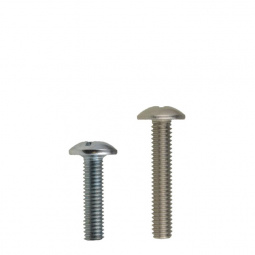
Mushroom Head Roofing Bolts -
Plow Bolts -
Purlin Flanged Bolts -
Sems -
Structural K0 Bolts & Nuts
Find the right bolts for your project at Bolt & Nut Australia. We stock 3,700+ industrial bolts online — hex, flange, cup head coach, K0 structural, coach screws, plow and purlin. Available in galvanised, stainless A2-70 G304 and A4-70 G316 marine, zinc silver, zinc yellow and brass. Order online for same-day Brisbane dispatch and free delivery Australia-wide.
TECHNICAL RESOURCES
Every bolt subcategory has its own CAD drawings and spec PDFs linked at the bottom of its page. For the full library covering bolts and every other product range we stock, see our Technical PDF's Library.