Header imageFREE Delivery Header imageAustralian OwnedHeader imageSpend DISCOUNTS

Pins & Clips

Pins & Clips

Pins, Clips and Circlips for Mechanical Fastening and Retention

Pins and clips are the headless fastening family - used to lock shafts, retain components on axles, align machine parts, secure pivots, and create positive mechanical stops. Unlike threaded fasteners they don't clamp by tension; they hold by interference fit, spring tension, mechanical locking or by spanning a groove or hole.

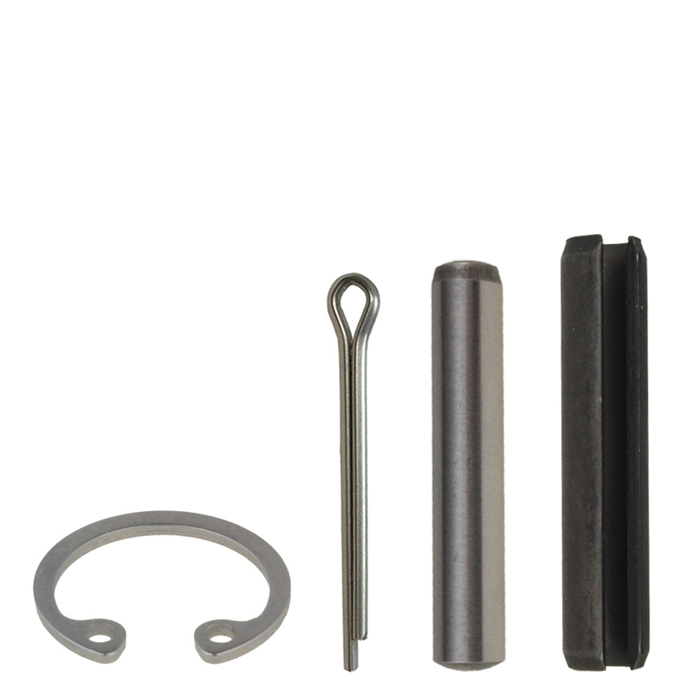
The range covers spring roll pins (ISO 8752 slotted, JIS B 2808 wave), cotter split pins (DIN 94), dowel pins (DIN 6325 hardened, DIN 7 stainless), circlips (DIN 471 external, DIN 472 internal, JIS B2805 E-type), linch pins (DIN 6799), R-clip humpback pins and self-locking starlock push nuts. Sizing varies by family - roll pins and dowels by pin diameter and length, circlips by the shaft or bore diameter they fit, push nuts by the shaft diameter they grip.

We've been supplying these online from Brisbane for over 15 years. With 25,000 stock lines and over 200 million pieces in stock, we carry one of the most comprehensive ranges of pins, clips and circlips available in Australia — from spring roll pins, slotted and wave variants to cotter split pins, dowel pins, circlips, linch pins, R-clip humpback pins and push nuts. Save more as you buy more — we offer up to 13 price breaks plus 3 spend-tier discounts.

MATERIALS AND COATINGS

Stainless A2-70 G304 covers most marine and food-grade applications - A2 / G304 is austenitic chrome-nickel stainless with excellent corrosion resistance in general atmospheric and washdown environments. Largely non-magnetic in the supplied annealed condition (cold-worked installation may induce some magnetism - see are stainless fasteners magnetic?). Use A2 for general indoor / mild outdoor retention.

Stainless A4-70 G316 (molybdenum-bearing) is the marine-grade upgrade - specify A4 / G316 wherever chlorides, salt spray, or coastal exposure are likely. Cotter pins, linch pins and dowel pins are all available in A4-70.

G420 Martensitic Stainless is used on E-type circlips and wave spring roll pins where a higher hardness is needed to maintain spring tension. G420 is harder than A2 / A4 austenitic but offers lower corrosion resistance - suited to indoor / dry applications.

Hardened Alloy Steel (Plain Black Uncoated) is the standard for parallel dowel pins (DIN 6325) where a tight interference fit and precision-ground OD are critical. Surface hardness Rockwell 58-62 HRC. Uncoated finish keeps the OD to tolerance - protect from corrosion during storage.

Hardened Carbon Steel with Black Oxide is the finish for slotted spring roll pins (ISO 8752) and self-locking push nuts. The black oxide is a thin conversion coating that resists shop-floor rust without adding to the OD or affecting spring tension.

Zinc Silver Plated Carbon Steel covers most cotter split pins and R-clip humpback pins - economical corrosion protection suited to general workshop, automotive and agricultural retention. Not recommended for prolonged outdoor or marine exposure.

HOW LENGTH AND SIZE ARE MEASURED

Pins and clips are measured differently depending on the family - the dimension on the label tells you the reference dimension used by the relevant standard:

Spring Roll Pins (slotted, coiled, wave): measured end-to-end. The pin compresses radially as it enters the hole and grips by spring tension. Match the length to the combined thickness of the parts being pinned.

Cotter Split Pins: measured from the underside of the eye to the tip of the legs. The eye sits on top of the hole and the legs are folded back to lock. Allow enough leg past the hole to fold back without interfering with adjacent components.

Dowel Pins: measured end-to-end (no head, no chamfer offset). Match the length to the combined depth of the two mating holes, leaving clearance at the blind end.

Circlips: not measured by length - sized by the shaft diameter they fit (external circlips, DIN 471) or the bore diameter they sit inside (internal circlips, DIN 472). The free OD, groove width and groove diameter are listed on the product page.

Linch Pins and R-Clip Humpback Pins: measured by the length of the straight leg that passes through the hole. The bent arm or ring sits clear of the work and locks the pin in place.

Push Nuts (Starlocks): sized by the shaft diameter they grip - push nuts have no length and are not measured end-to-end.

A NOTE ON GALLING

Stainless-on-stainless contact under load can gall (cold-weld) - particularly on interference-fit dowel pins driven into stainless host holes. To avoid: install with a light anti-seize lubricant (food-grade if required), drive with steady force at moderate speed, and avoid hammering at an angle that wedges the pin. Galling is not a concern on spring roll pins, cotter pins or circlips because the contact area is small and the load is shared across the spring or groove.

OUR RANGE

Spring Roll Pins - ISO 8752 slotted spring roll pins in hardened carbon steel with black oxide finish. M1.5 through M16 nominal diameter with lengths from 4mm to 100mm. The slotted spring design compresses on installation and grips the host hole by spring tension - no thread, no head, repeatable retention even after multiple removal cycles.

Wave Spring Roll Pins - JIS B 2808:1999 wave-tooth spring pins in G420 martensitic stainless. The wave profile distributes radial force more evenly than slotted pins and resists fatigue better under repeated load reversal. M2 to M8 nominal, lengths to 50mm.

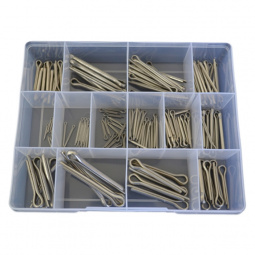
Cotter Split Pins - DIN 94 cotter pins in zinc-plated steel and A4-70 G316 stainless. The classic safety pin used to lock castellated nuts on axles, retain pivot pins. Pin diameters from 1mm to 6.3mm with lengths from 10mm to 80mm.

Dowel Pins - DIN 6325 parallel hardened pins (Rockwell 58-62 HRC, plain uncoated) and DIN 7 stainless dowels. Precision-ground OD with interference fit for accurate location of jigs, fixtures, die sets, motor mounts and machine assemblies. M1 to M16 metric and imperial sizes 1/16" to 5/8".

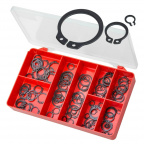
Circlips - DIN 471 external (shaft) circlips, DIN 472 internal (bore) circlips and JIS B2805 E-type circlips, all in stainless. Shaft sizes from 1.2mm to 100mm. External circlips sit in a groove on a shaft to retain wheels, bearings, sleeves; internal circlips sit in a bore to retain shafts in housings.

Linch Pins - DIN 6799 stainless linch pins. Quick-release retention for trailer drawbars, towed implements, pin assemblies on agricultural and automotive equipment. Shaft diameters from 4.2mm to 6mm with leg lengths from 48mm to 56mm.

R-Clip Humpback Pins - Zinc-plated steel R-clips, also called hairpin cotters. The bent arm acts as a spring to lock the straight leg through the cross-hole. Quick-release retention for hitch pins, shaft ends and cross-pin assemblies. Pin diameter 1.2mm to 1.6mm.

Push Nuts (Starlock) - Self-locking push-on retainers in hardened steel with black oxide and A2-70 G304 stainless. The internal teeth bite into the shaft as it passes through, locking against back-out. Used for axle retention on castors, toys, light retention assemblies. Shaft diameters 3mm to 12mm.

Need help choosing the right pin or sizing a circlip to your shaft groove? Our Technical PDF's Library has specification guides and standards references. Prices include GST and free standard delivery anywhere in Australia.

FREQUENTLY ASKED QUESTIONS

How do I choose between a slotted spring roll pin and a wave spring roll pin?

Slotted spring roll pins (ISO 8752) are the standard choice for static or moderate-cycle retention - the open slot lets the pin compress radially and grip by uniform spring force. Wave spring roll pins (JIS B 2808) use a wave profile that distributes radial force more evenly and resists fatigue better under repeated load reversal. Pick wave for high-cycle rotating or vibrating assemblies; pick slotted for general retention and pivot work.

What is the difference between a DIN 471 and DIN 472 circlip?

DIN 471 is an external circlip that fits in a groove around a shaft - the free OD is larger than the groove diameter so the clip springs INWARD to grip. DIN 472 is an internal circlip that fits in a groove inside a bore - the free OD is smaller than the bore so the clip springs OUTWARD to grip. The two are NOT interchangeable. Match the part number on the product page to the groove dimension on your assembly drawing.

How do I measure a circlip to know what size to order?

Circlips are sized by the diameter they fit, not by their own free OD or thickness. For an external circlip, measure the shaft diameter (or the groove diameter on the drawing). For an internal circlip, measure the bore diameter. The product page lists the shaft / bore diameter, free OD, groove width and groove diameter for each part - cross-check against your assembly's spec to avoid the wrong fit.

Are stainless pins and clips magnetic?

A2-70 / G304 and A4-70 / G316 stainless are largely non-magnetic in the supplied annealed condition - the austenitic crystal structure isn't ferromagnetic. Cold-working (drawing, stamping, light hammering during install) can induce some martensitic transformation and create slight magnetic pickup. G420 martensitic stainless used on E-type circlips and wave spring pins IS magnetic by design - the higher hardness comes from a martensitic structure. See are stainless fasteners magnetic? for the metallurgy.

Can I reuse a spring roll pin after I drive it out?

Once a slotted spring roll pin has been driven through a hole and removed, the spring tension at the slotted edge has been partially lost. The pin will still hold for non-critical assembly, but for safety-critical or load-bearing joints, plan on a fresh pin every time. Wave spring roll pins recover better than slotted because the radial force is distributed across the wave profile - still, on rotating or vibrating assemblies, replace at scheduled maintenance.

Why does my cotter split pin keep cutting through during installation?

Cotter split pin material is soft on purpose - it has to fold back without cracking. If the pin is shearing as you fold it, three things are usually wrong: (1) the host hole is too small for the pin's full diameter (check the leg shape - tapered pins need a slightly larger hole than parallel), (2) the legs are being folded back too tightly against a sharp corner instead of being spread, or (3) the pin grade is wrong - A4-70 G316 stainless has less ductility than zinc-plated mild steel. For tight folds, use the zinc-plated DIN 94 variant.

How do I drive a hardened dowel pin without damaging the OD?

DIN 6325 parallel hardened dowel pins are precision-ground to within microns - the interference fit relies on the OD being intact. Drive the pin with a flat-face soft hammer (brass, copper or hide), squarely down the pin axis. Never drive at an angle. If the pin won't enter cleanly, the host hole is too small (under-reamed) - drill / ream to the specified clearance. For longer pins, use a dowel-pin punch with a recess that captures the OD and applies force only to the end face.

What's the difference between a linch pin and an R-clip humpback pin?

Both lock a straight leg through a cross-hole with a spring-loaded retaining feature. Linch pins have a hinged steel ring that snaps over the head and locks against the work face - they're heavier-duty and used on agricultural equipment, trailers, and tow setups. R-clip humpback pins (hairpin cotters) have a bent wire arm that acts as the spring - they're lighter and used for hitch pins, shaft ends, and cross-pin assemblies on general-purpose machinery. Pick linch for outdoor / heavy-cycle use; pick R-clip for lighter quick-release work.

Do push nuts need a thread on the shaft?

No. Push nuts (Starlocks) are designed to grip a smooth plain shaft - the internal teeth bite into the metal as the nut is pushed on, and lock against any attempt at back-out. The shaft must be the correct diameter (push nuts are sized to fit a specific shaft OD) and should be free of grease or oil that would reduce the bite. Push nuts are one-way - removing them usually damages the shaft surface and the nut.

What standard covers each pin type?

Spring roll pins are ISO 8752 (slotted) and JIS B 2808:1999 (wave). Cotter split pins are DIN 94. Parallel hardened dowel pins are DIN 6325 (plain) and DIN 7 (stainless). Circlips are DIN 471 (external), DIN 472 (internal) and JIS B2805 (E-type). Linch pins are DIN 6799. Each product page lists the applicable standard for that SKU. Use the standard number when comparing across suppliers - it locks the dimensions, tolerances and material spec.

How tight is the hole for a slotted spring roll pin?

ISO 8752 specifies the host hole diameter to the nominal pin diameter - the pin compresses radially on installation, so the hole is sized very slightly smaller than the pin's free OD. Each SKU on the site lists the hole size to suit in the technical specifications table. As a rule of thumb, host hole diameter equals the pin's nominal label diameter, and the pin's actual free OD is 1-3% larger. For high-load or repeated-cycle assemblies, reaming the hole gives a more uniform fit than drilling alone.

Are push nuts safety-rated for load-bearing axle retention?

Push nuts are designed for light retention on castors, light wheels, toys, control-knob axles and similar low-load applications. They are NOT a safety-rated wheel-retention device for vehicles, trailers, or anything subject to sustained axial load or fatigue. For trailer wheels, castle nuts with cotter pins (DIN 94) or split-collar systems are the right call. If in doubt, get in touch and we'll point you to the right retention method.

WHY AUSTRALIA TRUSTS BOLT & NUT

With 15+ years selling fasteners online from Brisbane, we hold over 25,000 stock lines and 200 million pieces - 98.75% of online orders placed before 1pm leave same day. Save more as you buy more - we offer up to 13 price breaks plus 3 spend-tier discounts. Read our customer reviews or get in touch if you need help picking the right pin, clip or circlip.

  1. Close Icon
    Circlips
  2. Close Icon
    Cotter Split Pins
  3. Close Icon
    Dowel Pins
  4. Close Icon
    Linch Pins
  5. Close Icon
    Push Nuts
  6. Close Icon
    R Clip Humpback Pins
  7. Close Icon
    Spring Roll Pins
  8. Close Icon
    Wave Spring Roll Pins
View as Grid List

Items 1-40 of 197

Set Descending Direction
Page
per page

Pins, clips and circlips from Bolt & Nut Australia. 700+ variants online across spring roll, cotter split, dowel, circlip, linch, R-clip and push nut. Stainless A2/A4, hardened, zinc plated, black oxide. Same-day Brisbane dispatch.

TECHNICAL RESOURCES

Standards covered across the range: DIN 471 / DIN 472 (circlips), JIS B2805 (E-type circlips), DIN 94 (cotter split pins), DIN 6325 (parallel hardened dowels), DIN 7 (stainless dowels), ISO 8752 (slotted spring roll pins), JIS B 2808:1999 (wave spring roll pins), DIN 6799 (linch pins). Full PDFs available on each sub-category page.

For the full library of charts and specs, see our Technical PDF's Library.

scroll icon