Header imageFREE Delivery Header imageAustralian OwnedHeader imageSpend DISCOUNTS

Marine & Hardware

Marine & Hardware

Stainless Marine, Rigging and Hardware Fittings

Marine and hardware fittings cover the joining, lifting, securing and tensioning hardware that isn't a standard bolt or nut - shackles, eye bolts, pad eyes, turnbuckles, rigging screws, hooks, swivels and hinges. The range is overwhelmingly stainless steel because marine, coastal and industrial-rigging environments will rust out anything less. Bolt & Nut Australia stocks 190+ fittings across Stainless A4-70 G316 and A2-70 G304 from Brisbane.

We've been supplying these online from Brisbane for over 15 years. With 25,000 stock lines and over 200 million pieces in stock, we carry one of the most comprehensive ranges of marine and hardware fittings available in Australia — from Stainless A4-70 G316 and A2-70 G304 - shackles, eye bolts, eye nuts, hinges, hose clamps, pad eyes, rigging screws, S hooks, snap hooks, spring hooks, swivels, toggle latches, turnbuckles and double-thread lag screws. Save more as you buy more — we offer up to 13 price breaks plus 3 spend-tier discounts.

STAINLESS GRADE - A2-70 G304 vs A4-70 G316

A2-70 (Stainless Grade 304): the general stainless grade. Tensile strength ~700 MPa minimum (the '70' in A2-70 = 700 MPa). Used where stainless is needed but the environment isn't directly exposed to seawater spray or chlorine. Suitable for sheltered marine fittings, inland river and lake fittings, freshwater pool hardware, and general outdoor rigging in non-coastal locations.

A4-70 (Stainless Grade 316): marine-grade stainless. Same 700 MPa tensile but with 2-3% added molybdenum which dramatically improves resistance to chloride pitting. The standard grade for direct seawater immersion, ocean spray exposure, chlorinated pool plant, and food-grade processing equipment. Costs ~20% more than A2-70 but lasts 3-5x as long in saltwater. The default specification for any genuine marine application.

Stainless is largely non-magnetic - but the cold-forming used to produce many marine fittings (eye bolts, S hooks, swivels) can introduce slight residual magnetism. The bulk corrosion behaviour is unaffected.

A NOTE ON GALLING

Stainless threads in tension can gall - the two austenitic surfaces cold-weld under load and the fastener seizes before reaching full tightness. To prevent galling: tighten slowly, never with an impact driver; apply a marine-grade anti-seize compound (nickel-based) to the male thread before assembly; never re-use a fastener that has galled. The Anti-Seize range carries the matching nickel-based compound.

WORKING LOAD LIMITS (WLL) AND SAFE USE

Marine fittings carry a published Working Load Limit (WLL). The WLL is the maximum load the fitting is rated to carry in normal service - typically 1/4 to 1/5 of the fitting's ultimate break load to give a safety margin against shock loading, fatigue and minor manufacturing variation. Always size the fitting to the load you're carrying including any dynamic load multiplier (wave loading, swinging loads). When in doubt, step up a size.

Per-SKU WLL data is published against every fitting in the range. The WLL is the working spec to design to - the break load is the destruction load and should never be approached in service.

INSPECTION AND RETIREMENT

Rigging and marine hardware wear out. Catching wear early - before a fitting fails under load - is the single biggest safety practice in marine and rigging work. Build a periodic inspection routine into every assembly you own and retire any fitting that fails any of the criteria below.

Dee shackles: retire when the pin or body shows visible deformation (bending, ovaling at the pin hole, elongation under repeat load), when the pin thread strips or galls (won't tighten or unscrew cleanly), or when the pin diameter has worn by more than 5% measured with callipers at the load-bearing midpoint. Cracks anywhere on the body are a retire-now finding - never grind out or weld-repair a stainless shackle.

Eye bolts and pad eyes: retire if the eye shows opening (eye no longer forms a closed loop), if the welds or forge joins show stress cracks, or if the thread shows pulling at the eye-to-shank transition (the highest-stressed point under axial load). Eye bolts must NEVER be loaded sideways - any fitting showing sideways-load damage retires immediately.

Turnbuckles and rigging screws: retire when the body shows thread stripping at the open ends, when the body bows under axial load (a bent body is a deformation flag), or when the jaw / eye fittings show wear at the pin hole. Replace any turnbuckle whose ends won't both lock against the body simultaneously.

Stainless surface condition: light tea-staining on A2-70 G304 in coastal use is cosmetic and doesn't indicate retirement. Pitting corrosion - small surface craters that grow over time - is a structural flag and the fitting retires when pits cover more than ~5% of the load-bearing surface. Crevice corrosion under washers or in tight thread joints is hidden and harder to inspect for - schedule full disassembly checks annually on safety-critical rigging.

General rule: if in doubt, retire and replace. The cost of a new stainless shackle is small compared to a load drop, a personal injury, or a vessel damaged at anchor. Use the customer reviews page to see how other Australian trade and marine users approach periodic inspection.

PIN RETENTION (MOUSING)

Dee shackle pins can work loose under vibration, swinging loads, sea conditions or repeated tensioning cycles. The standard trade practice for dynamic-load applications is to mouse the pin - tie a stainless wire through the pin's drilled hole (most stocked Dee shackles have this hole pre-drilled) and the shackle body. The wire prevents the pin backing off even if the thread loosens.

When to mouse: any shackle in marine rigging where load direction changes (swinging boom, ground tackle, mast stays), in lifting hardware where the shackle sees swing or shock load, in fall-arrest and safety-critical anchor systems, and in any installation where the shackle is hard to inspect after install (out of sight, overhead, or below the water line).

How to mouse: use 1mm or 1.5mm stainless lock wire (A4-70 G316 to match the shackle grade). Thread one end through the drilled hole in the pin head, loop the wire across the body of the shackle to the matching hole on the body (or around the body if there's no body hole), twist the two ends with pliers to lock. Trim the twist tail and tuck it in so it can't snag rigging or cut hands during service. The mouse wire is itself an inspection item - check it visually during every rigging walk-around.

Alternatives to mousing: threadlocker compound on the pin thread (medium-strength) is acceptable for static-load applications but won't survive cyclic loading the way mechanical mousing does. Secondary safety pins (cotter pin through a drilled shackle pin) provide the most positive mechanical retention but require a shackle pin with a transverse-drilled tail - special-order via Contact us.

Eye bolts, turnbuckles and rigging screws have equivalent retention options - lock nuts, jam nuts and mechanical locking devices. Match the retention method to the load conditions: static loads accept threadlocker; dynamic loads need mechanical retention.

OUR RANGE

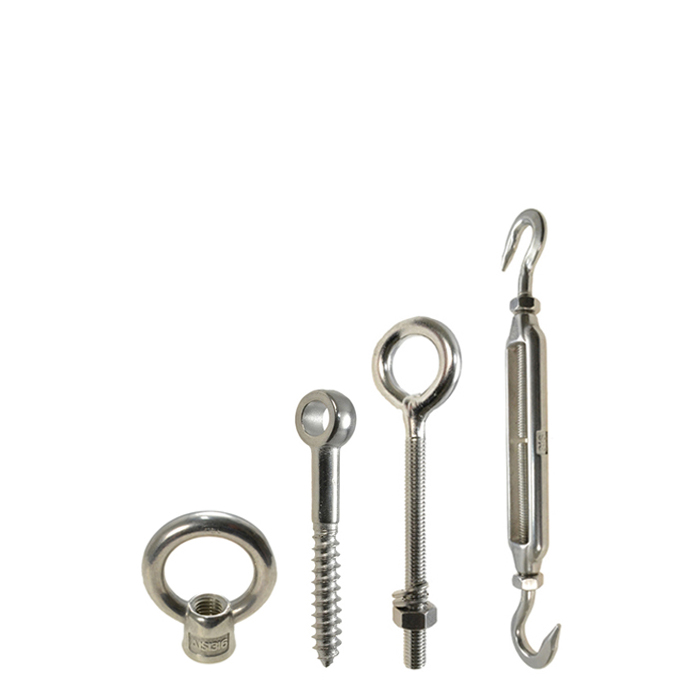
Dee Shackles — Bow (D-shape) shackles in Stainless A4-70 G316. The workshop-default rigging shackle - pin-and-body design joins chain, rope, slings and webbing.

Eye Bolts — Threaded eye bolts (eye one end, machine thread the other) in A2-70 G304. Anchor for slings, ropes and rigging hardware. M5 through M16. Includes nut and washer.

Eye Nuts — Threaded eye nuts in A4-70 G316. The female-thread complement to eye bolts - turn an existing bolt or stud into a rigging attachment point. M6 through M12.

Pad Eyes — Round and oblong pad eyes in A2-70 G304. Bolt-mounted attachment plates with a central eye - permanent rigging anchor for ropes, slings and ties.

Rigging Screws — Jaw & Jaw rigging screws (turnbuckles with jaw ends) in A4-70 G316. Adjustable-tension rigging for marine and architectural cable work. M5 through M8.

Turnbuckles — Eye & Eye and other turnbuckle styles in A4-70 G316. The standard tensioning device for cable, rod and rope rigging. M4 through M16.

Cast Snap Hooks — Lever-release stainless snap hooks in A4-70 G316. Quick-attach hooks for marine, livestock and outdoor rigging.

S Hooks — Long-arm S-hooks in A2-70 G304. Open-end stainless hooks for hanging, chain extension and general utility hooking.

Spring Hooks — Spring-loaded gate hooks in A4-70 G316. Like a snap hook but with a spring-loaded gate - secure attachment that releases under deliberate hand pressure.

Swivels — Eye & Eye stainless swivels in A4-70 G316. Allow a connected line to rotate freely without twisting the rigging upstream.

Saddle Eye Straps — Bolt-on stainless saddle straps in A2-70 G304. Mount over a deck or panel to provide a low-profile rope or strap attachment point.

Hose Clamps — Worm-drive stainless hose clamps in A2-70 G304 (band) with zinc-plated drive bolt. Universal-band format covers hose ranges from 10mm to 220mm.

Hinges — Fixed-pin stainless hinges in A2-70 G304. Sold in pairs. Standard sizes for box, panel and cabinet construction.

Toggle Latches — Adjustable stainless toggle latches in A2-70 G304. Secure-and-release latching for boxes, panels and equipment covers.

Lag Eye Screws — Eye-bolt-with-wood-thread in Stainless A4-70 G316. Screw directly into timber for a permanent rigging attachment - no nut required.

Double Thread Lag Screws — Hanger bolts (machine thread one end, wood thread the other) in A4-70 G316. Mount machine-thread hardware into timber substrate. M8 and M10.

Conduit Saddles — Half-conduit zinc-plated saddles for electrical conduit fixing. 16mm and 20mm conduit sizes. The non-stainless exception in this category.

Need help choosing the right grade or size? Our Technical PDF's Library has specification guides and technical charts. Prices include GST and free standard delivery anywhere in Australia.

FREQUENTLY ASKED QUESTIONS

Which stainless grade do I need for marine use?

A4-70 G316 for any direct saltwater or salt-spray exposure (boats, dock hardware, coastal rigging within 200m of the surf line, marina pontoons). A2-70 G304 for sheltered marine and freshwater work - inland river craft, freshwater pool hardware, lake rigging, indoor industrial work where stainless is preferred but salt isn't a factor. When in doubt, step up to G316.

What does A4-70 actually mean?

A4 = the grade (austenitic stainless 316 family). The 70 = the minimum tensile strength in MPa divided by 10 - so A4-70 = 700 MPa minimum tensile. A2-70 = 304 family, 700 MPa minimum. A2-80 and A4-80 are work-hardened versions at 800 MPa. Most marine and rigging hardware is A4-70 (the marine balance of strength + corrosion + cost).

What's the difference between a Dee shackle and a Bow shackle?

Strictly speaking: D-shackles are narrower at the bow end for inline (rope-to-rope) connections. Bow shackles are wider for multiple-leg connections (multiple slings into one anchor). In the BNA range the term 'Dee Shackle' refers to the bow-form stainless rigging shackle - the workshop-default rigging connector. For specific D vs Bow distinctions, contact us.

How tight should a Dee shackle pin be?

Hand-tight plus a quarter-turn snug with a spanner. Over-tightening can deform the body or strip the thread; under-tightening lets the pin work loose under vibration. For dynamic load applications (rocking, sea conditions), mouse the pin - tie a wire through the pin's drilled hole and the shackle body to prevent accidental opening.

Can I use a stainless eye bolt for overhead lifting?

Only forged eye bolts rated for lifting are safe for overhead lifting. Standard stainless eye bolts (M-machined thread, bent eye) are NOT lifting-rated and must not be used overhead - the bent eye can open under shock load. For overhead lifting, source forged shoulder eye bolts with a published WLL marked on the body. We stock the rigging-grade equivalent; for lifting-specific eye bolts, contact us.

Why does stainless rigging gall when I tighten it?

The two stainless surfaces cold-weld under contact pressure - the engaging thread peaks stick to each other, the fastener seizes part-way down and can't be turned further or removed. Anti-seize compound prevents this; slow assembly speed prevents this; never using an impact driver prevents this. Once a stainless fitting has galled, it's scrap - the threads are destroyed and can't be repaired.

How do I size a turnbuckle to a wire rope?

Match the turnbuckle's working load limit (WLL) to the wire rope's WLL - the turnbuckle should be at LEAST as strong as the rope it tensions. For a 5mm 7x19 stainless wire rope (~250kg WLL), use an M5 or M6 turnbuckle. The published per-SKU WLL is on every turnbuckle page.

Can I cut a stainless rigging screw to length?

Yes for the open shaft section, but never the thread. Cut with an angle grinder or hacksaw, dress the cut end with a file, and chase the cut threads with a tap if you've cut into the threaded section. For long-term marine use, paint the cut end with cold-galv or a metal sealer to prevent crevice corrosion at the exposed core.

What's the difference between A2-70 and A4-70 in salt water?

A2-70 (G304) shows surface tea-staining within weeks and pitting corrosion within 12-24 months of direct saltwater exposure. A4-70 (G316) holds bright finish for years and resists pitting corrosion for the design life of the assembly (10-20 years typical). For marine work, the cost premium of G316 is repaid many times over in service life.

Are conduit saddles really not stainless?

Correct - the conduit saddle range is zinc-plated steel, not stainless. Conduit saddles are the one electrical-trade exception in this category - they're typically used in roof spaces, switchboards and conduit runs where the environment is dry and zinc plating is sufficient. For genuine marine or wet-area conduit fixing, specify a stainless saddle as a special order via Contact us.

Where can I find the WLL data for all of the fittings?

Per-SKU WLL is published on every product page. For an overview chart across the range, see Technical PDF's Library. WLL is the working load - design the rigging to keep the actual load below the published WLL with appropriate safety margin for dynamic loading.

Are these fittings sold individually or in pairs?

Most are individual fittings. Hinges are sold in pairs (the way they're used). Hose clamps and conduit saddles are individual. The per-SKU 'Sold as' detail is on every product page.

WHY AUSTRALIA TRUSTS BOLT & NUT

With 15+ years selling fasteners online from Brisbane, we hold over 25,000 stock lines and 200 million pieces - 98.75% of online orders placed before 1pm leave same day. Save more as you buy more - we offer up to 13 price breaks plus 3 spend-tier discounts. Read our customer reviews or get in touch if you need help picking the right marine or hardware fitting.

  1. Close Icon
    Cast Snap Hook
  2. Close Icon
    Conduit Saddles
  3. Close Icon
    Dee Shackles
  4. Close Icon
    Double Thread Lag Screws
  5. Close Icon
    Eye Bolts
  6. Close Icon
    Eye Nuts
  7. Close Icon
    Hinges
  8. Close Icon
    Hose Clamps
  9. Close Icon
    Lag Eye Screws
  10. Close Icon
    Linch Pins
  11. Close Icon
    Pad Eyes
  12. Close Icon
    Rigging Screws
  13. Close Icon
    S Hooks
  14. Close Icon
    Saddle Eye Straps
  15. Close Icon
    Spring Hooks
  16. Close Icon
    Swivels
  17. Close Icon
    Toggle Latches
  18. Close Icon
    Turnbuckles
  19. Close Icon
    U Bolts
View as Grid List

Items 1-40 of 315

Set Descending Direction
Page
per page

Marine and rigging hardware in Stainless A4-70 G316 and A2-70 G304 - shackles, eye bolts, eye nuts, hinges, hose clamps, pad eyes, rigging screws, S hooks, spring hooks, swivels, turnbuckles. Same-day Brisbane dispatch.

scroll icon