Header imageFREE Delivery Header imageAustralian OwnedHeader imageSpend DISCOUNTS

Rivets

Rivets

Pop Blind Rivets for Sheet Metal, Aluminium, Plastic, Fibreglass and Timber

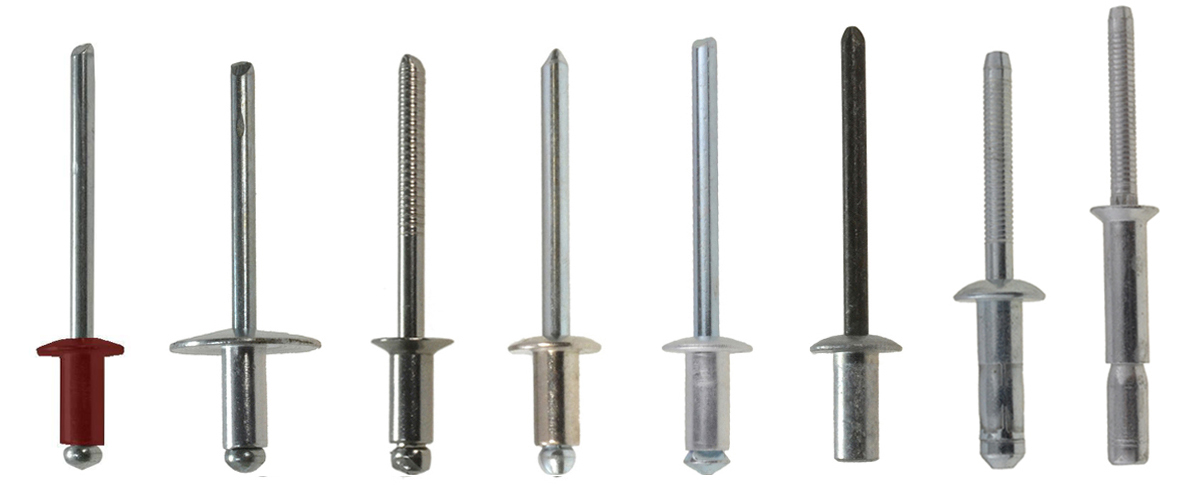
A pop blind rivet is a two-part fastener consisting of a shell and a headed stem (mandrel). The rivet is set by drawing the stem through the shell, which causes the body to expand and clamp the workpieces tightly together. Once the desired clamping force is reached, the stem breaks off at a predetermined position and is discarded. Part of the stem remains trapped in the shell to retain the clamping force in the joint — this is what makes the rivet permanent.

Used for fastening sheet metal, aluminium, thin steel, plastic, fibreglass and timber. Common in signage, panel assembly, HVAC ducting, automotive trim, electronics enclosures, marine fabrication, trailer manufacture and structural metalwork. Pop rivets are blind fasteners — they can be set from one side of the workpiece without needing access to the back. For applications requiring a threaded insert (where a bolt or screw needs to thread into thin sheet later), see our rivet nuts (nutserts) range instead.

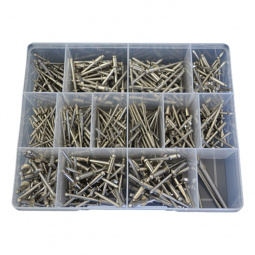
We stock 429 pop blind rivet variants from our Brisbane warehouse across 11 subcategories — dome, countersunk and large-flange heads in standard, painted, sealed, peeled, multigrip and structural (Anlock Mega Lock) types. Body diameters from 2.4mm (3/32") to 6.4mm (1/4"). Materials from aluminium / steel everyday rivets through to stainless steel for outdoor and marine exposure, Monel / steel for chemical resistance, and zinc-plated structural rivets for heavy-duty fabrication.

Check our reviews from DIY, tradespeople, builders, manufacturers, government, councils and engineers across Australia.

MATERIALS AND COATINGS

Aluminium shell / Steel stem — The everyday general-purpose pop rivet (226 variants in our range). The soft aluminium shell sets cleanly with low pull force; the steel stem provides the strength to draw the rivet without breaking prematurely. Suitable for indoor work and most outdoor applications, though the steel stem stub will rust over time in wet exposure.

Stainless steel — 125 variants in our range. Both shell AND stem in stainless — the right choice for outdoor, marine, treated-timber and chemical-exposure applications where the steel stub of an aluminium / steel rivet would rust. Non-magnetic in annealed condition (slightly magnetic after the rivet is set due to cold-working — see our stainless magnetism FAQ).

All-aluminium — 28 variants. Both shell and stem aluminium. The lightest and softest combination — sets with very low pull force. Used where weight matters (aerospace, automotive) or where the rivet must be galvanically compatible with an aluminium substrate (mixing materials accelerates corrosion via galvanic action).

Steel shell / Steel stem — 22 variants. All-steel construction for higher strength than aluminium rivets. Used in structural fabrication and in machinery where shear loads are higher. Zinc plated for moderate corrosion resistance.

Monel shell / Steel stem — 17 variants. Monel is a nickel-copper alloy with excellent corrosion resistance in marine and chemical environments — better than even stainless steel in salt water. Premium-priced; specified where the rivet location is critical and unreachable for replacement.

Zinc-plated structural — 8 variants. The Anlock Mega Lock structural range. Heavy-duty rivets where the mandrel is retained inside the shell after setting — delivering shear strength comparable to a small bolt.

Copper shell / Steel stem — 3 variants. Niche use — electrical work where copper conductivity matters, decorative work where the warm copper colour is wanted, and lightning-rod / earthing assemblies.

HEAD STYLES

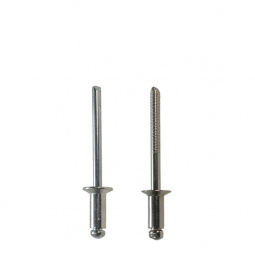
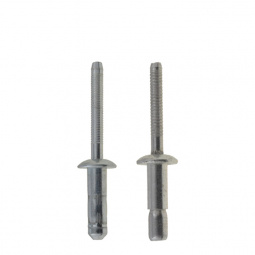
Dome Head — The default head style (321 variants). Slightly domed top with a flat underside — the head sits proud of the workpiece with a wider load-spreading footprint than countersunk. Used in general sheet-metal assembly, signage, panel work, automotive trim.

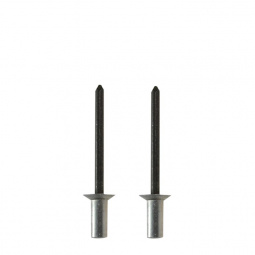
Countersunk Head — 66 variants. 90-degree conical underside that sits flush with the substrate when set in a countersunk hole. Used wherever the head must not stand proud — aerodynamic surfaces, trim work, casework, anywhere a smooth finished surface is required.

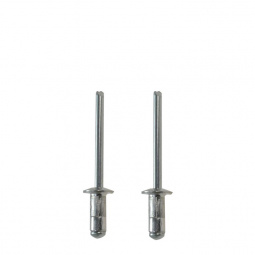
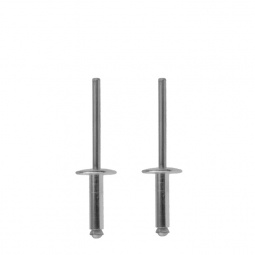
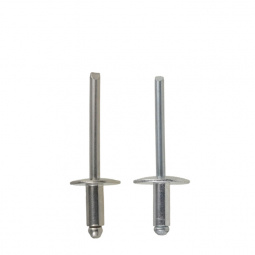
Large Flange Head — 42 variants. Oversized flange spreads load across a wider footprint than the standard dome — the right choice for thin sheet metal, plastic, fibreglass and other soft / thin substrates where pull-through is the failure mode.

RIVET TYPES

Standard pop rivets — The everyday open-end rivet. The shell tube is open at the back; the mandrel pulls through and breaks at the predetermined point, leaving a small open hole at the back of the joint.

Sealed (closed-end) rivets — The shell is closed at the back of the rivet. Once set, the joint is permanently watertight and airtight. Used in fluid containers, marine fabrication, refrigeration, outdoor electronics enclosures.

Peeled (splayed) rivets — The shell is engineered to split into four petals as the mandrel draws through. The petals create a much wider back-side footprint than a standard rivet — the right choice for soft substrates like timber, plastic and fibreglass where standard rivets would pull through.

Multigrip rivets — Designed to accommodate a wider material-thickness range than a standard rivet. One multigrip rivet covers what would otherwise need two or three different rivet lengths. Useful in mixed-thickness assembly where you don't want to stock multiple lengths.

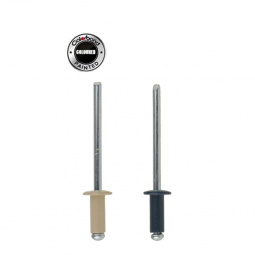
Painted rivets — Colour-matched head finish for visible architectural and shopfitting work. The body and stem are standard aluminium / steel; only the head is painted.

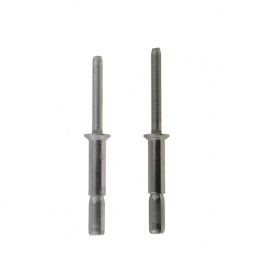
Structural rivets (Anlock Mega Lock) — Heavy-duty rivets where the mandrel is permanently retained inside the shell after setting. Delivers shear strength comparable to a small bolt — used in structural fabrication, trailer manufacture, large signage frames, structural panel work.

SIZES

Pop blind rivets are sized by body diameter. Available across the full standard range:

2.4mm (3/32") · 3.2mm (1/8") · 4.0mm (5/32") · 4.8mm (3/16") · 6.4mm (1/4")

Each rivet is also specified by length (the un-set length of the shell), which must match the combined thickness of the materials being joined. This is the rivet's grip range — the minimum and maximum material thickness it can clamp together. Each product page shows the specific grip range.

STANDARDS

DIN7337 — The German Industrial Standard for pop blind rivets. Internationally recognised — 405 of our 429 rivet variants are manufactured to this spec. Covers the geometric tolerances and mechanical properties for the standard, sealed, peeled, multigrip and large-flange types.

Anlock Mega Lock (proprietary) — The 24 structural rivets in our range follow the Anlock Mega Lock manufacturer specification rather than DIN7337. Mandrel retention and the resulting shear strength are not covered by the standard DIN spec, so structural rivets are specified to the manufacturer's data sheets instead.

OUR RANGE

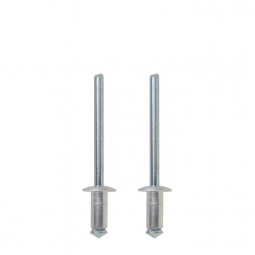
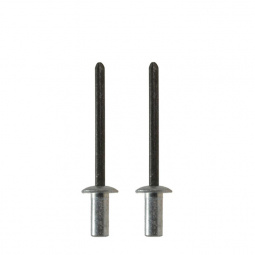
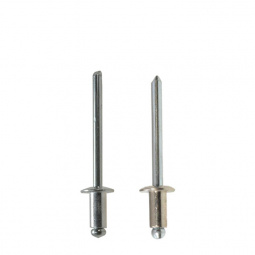
Dome Standard Pop Blind Rivets — 172 standard dome-head pop blind rivets — the everyday choice. Domed head sits proud of the workpiece, providing a clean finished look with good load-spreading. Available in stainless steel, aluminium / steel, steel / steel, aluminium, Monel / steel and copper / steel shell-stem combinations. Sizes 2.4mm through 6.4mm in DIN7337.

Dome Painted Pop Blind Rivets — 72 painted dome-head pop blind rivets in aluminium / steel construction. Painted heads provide a colour-matched finish for visible work — signage, shopfitting, architectural panel cladding. Sizes 3.2mm and 4mm in DIN7337.

Countersunk Standard Pop Blind Rivets — 43 countersunk-head pop blind rivets. Flush finish — the rivet head sits level with the workpiece surface when set into a countersunk hole. Used wherever the head must not stand proud. Aluminium / steel and stainless steel. Sizes 2.4mm through 6.4mm in DIN7337.

Dome Sealed Pop Blind Rivets — 38 sealed dome-head pop blind rivets. The closed-end shell forms a permanent watertight / airtight seal once set — used in fluid tanks, boat hulls, refrigeration ducts, electronics enclosures. Aluminium / steel and stainless steel. Sizes 3.2mm through 6.4mm in DIN7337.

Large Flange Pop Blind Rivets — 37 large-flange-head pop blind rivets. The oversized flange spreads load across a wider footprint — used in thin or soft materials (plastic, fibreglass, thin sheet) where pull-through is the failure mode you're designing against. Aluminium / steel and stainless steel. Sizes 3.2mm through 4.8mm in DIN7337.

Dome Peeled Pop Blind Rivets — 17 peeled (splayed) dome-head pop blind rivets. The shell splits into four petals as it sets, creating a much wider back-side footprint than a standard rivet. The right choice for soft substrates — timber, plywood, plastic, fibreglass — where pull-out resistance is critical. Aluminium / steel. Sizes 3.2mm through 4.8mm in DIN7337.

Structural Dome (Anlock Mega Lock) — 12 Anlock Mega Lock structural dome-head rivets. Heavy-duty monolithic-set rivets where the mandrel is permanently retained inside the shell after setting — delivering both clamping force AND shear strength comparable to a small bolt. Used in structural metalwork, trailer manufacture, signage frames. Stainless steel, aluminium and zinc-plated. 4.8mm and 6.4mm body diameters.

Structural Countersunk (Anlock Mega Lock) — 12 Anlock Mega Lock structural countersunk-head rivets. Same high-strength mandrel-retained construction as the structural dome range, but with a 90° countersunk head for flush finishing. Used in structural fabrication where the head can't stand proud. Stainless steel, aluminium and zinc-plated. 4.8mm and 6.4mm.

Countersunk Sealed Pop Blind Rivets — 11 sealed countersunk-head pop blind rivets. Closed-end + flush finish — for watertight joins that must also sit level with the workpiece. Aluminium / steel. Sizes 3.2mm through 4.8mm in DIN7337.

Dome Multigrip Pop Blind Rivets — 10 multigrip dome-head pop blind rivets. Engineered to accommodate a wider grip range than a standard rivet — one part covers what would otherwise require two or three different rivet lengths. Used in assembly where panel thickness varies. Aluminium / steel. Sizes 3.2mm through 4.8mm in DIN7337.

Large Flange Peeled Pop Blind Rivets — 5 large-flange peeled pop blind rivets. Combines the wider load-spreading footprint of a large flange with the splayed-petal back-side anchorage of a peeled rivet — for very soft or thin substrates. Aluminium / steel. 4.8mm body.

FREQUENTLY ASKED QUESTIONS

Can stainless fasteners be used with aluminium?

Yes — and for most applications, no special precautions are needed. The combination is widely used in industries where strength and corrosion resistance matter (marine, automotive, structural aluminium). For applications with sustained moisture or salt exposure, a few simple steps (barrier washer, sealant, matched-anodising) prevent any long-term galvanic corrosion concerns. Full guidance: Can stainless fasteners be used with aluminium?

What size drill bit do I use for a pop rivet?

The drill bit needs to be roughly 0.1mm larger than the rivet body diameter so the rivet inserts cleanly without distortion. Use this table as a reference:

Rivet body diameterDrill bit (metric)Drill bit (imperial)
2.4mm2.5mm3/32"
3.2mm3.3mm1/8"
4.0mm4.1mm5/32"
4.8mm4.9mm3/16"
6.4mm6.5mm1/4"

The general rule: drill ~0.1mm larger than the rivet body diameter. Avoid drilling too tight (the rivet won't insert cleanly) or too loose (the joint loses clamping force). Need help measuring the rivet itself? See our step-by-step guide on how to identify and measure blind rivets.

How does a pop blind rivet work?

The rivet is ‘set’ by drawing the stem (mandrel) through the shell using a rivet gun. As the mandrel pulls through, it expands the shell on the blind (back) side of the workpiece, clamping the materials together. Once the desired clamping force is reached, the mandrel breaks off at a predetermined position and the discarded stem is captured by the gun. A small portion of the stem remains permanently trapped in the shell — this is what retains the clamping force in the joint.

What's the difference between standard, sealed, peeled, multigrip and structural rivets?

Standard — the everyday open-end pop rivet. Cheapest, most common. Sealed (closed-end) — the shell is closed at the back, creating a watertight / airtight joint after setting. Used in fluid tanks, marine, refrigeration. Peeled (splayed) — the shell splits into four petals as it sets, creating a much wider back-side footprint. The right choice for soft substrates like timber and plastic where a standard rivet would pull through. Multigrip — accommodates a wider material-thickness range than a standard rivet, simplifying stock. Structural (Anlock Mega Lock) — mandrel-retained rivet with shear strength comparable to a small bolt — for structural fabrication, not general sheet-metal work.

Which rivet material should I use?

As a general rule: the shell material of the rivet should be the same as the material under the head. If you're fastening aluminium to steel, use steel rivets (the shell goes against the steel). Part of the mandrel stem remains in the shell after setting. In the case of steel stems, this stub may rust in wet exposure — an undesirable attribute in many outdoor or marine settings. In these cases, choose a rivet with a stainless or aluminium stem instead. For chemical exposure, Monel/steel rivets give even better corrosion resistance than stainless.

Can pop rivets be used outdoors?

Stainless steel — yes, suitable for outdoor, marine and chemical exposure. The best general-purpose outdoor rivet. Monel / steel — yes, even better than stainless for salt water and chemical environments. Aluminium / steel — usable outdoors but the steel stem stub will rust over time. All-aluminium — good corrosion resistance from both the shell and the stem. Steel / steel (zinc plated) — the thin zinc layer rusts within months in wet exposure — INDOOR USE ONLY.

Can pop rivets fasten into timber?

Yes, but you need the right type. Standard pop rivets will pull through soft timber unless the substrate is dense. Use peeled rivets or large-flange rivets instead — the splayed petals or wide flange spread the load across a larger footprint, preventing pull-through into the timber. For pure timber-to-timber joins, a timber screw is usually the better fastener; for fixing thin steel or aluminium hardware to timber, peeled rivets in aluminium / steel work well.

Do I need to drill a pilot hole?

Yes — pop rivets are blind fasteners but they're NOT self-drilling. You always drill a hole first, sized per the table above. The rivet then inserts into the pre-drilled hole and is set by the rivet gun. For self-drilling fasteners that create their own hole and don't need a pre-drill, see our self-tapping and self-drilling screws range — though those are screws, not rivets, so they have a different mechanism.

What's a structural rivet (Anlock Mega Lock)?

A structural rivet is a heavy-duty pop rivet engineered to carry shear loads comparable to a small bolt. The key difference from a standard rivet is that the mandrel is permanently retained inside the shell after setting — it doesn't break off and discard. This locked-in mandrel adds significant strength to the joint — both clamping force AND shear resistance. Used in trailer manufacture, structural panel work, large signage frames, ladder rails and any application where a standard rivet wouldn't carry the design load. Available in 4.8mm and 6.4mm body diameters.

What standard are your rivets made to?

Standard, sealed, peeled, multigrip, large-flange and countersunk pop rivets are manufactured to DIN7337 — the German Industrial Standard internationally recognised for pop blind rivets. Structural rivets in our range follow the manufacturer specification for the Anlock Mega Lock product family rather than DIN7337, because the mandrel-retained construction isn't covered by the standard DIN spec.

Do I need any other parts to use a rivet?

Just a rivet gun (manual, pneumatic or battery). Rivets don't need nuts or washers — the rivet IS the fastener and the captured mandrel retains the clamping force on its own. If you need a threaded insert that lets you later thread a bolt or screw into thin sheet metal, that's a rivet nut (nutsert), which is a different fastener entirely.

WHY AUSTRALIA TRUSTS BOLT & NUT

Buy with confidence: 15+ years experience selling online, > 25,000 stock lines, 200 million pieces ex stock in Brisbane QLD

Prices: Includes GST, a Tax Invoice and Free Standard Delivery anywhere in Australia

Up to 13 price breaks and 3 levels of spend discounts available on every product.

98.75% of orders placed before 1pm leave our Brisbane warehouse the same day.

Read what our customers say — reviews from DIY, tradespeople, builders, manufacturers, government, councils and engineers across Australia.

  1. Close Icon
    Countersunk Sealed
  2. Close Icon
    Countersunk Standard
  3. Close Icon
    Dome Multigrip
  4. Close Icon
    Dome Painted
  5. Close Icon
    Dome Peeled
  6. Close Icon
    Dome Sealed
  7. Close Icon
    Dome Standard
  8. Close Icon
    Large Flange Peeled
  9. Close Icon
    Large Flange Standard
  10. Close Icon
    Structural Countersunk
  11. Close Icon
    Structural Dome
  12. Close Icon
    Tools
View as Grid List

Items 1-40 of 437

Set Descending Direction
Page
per page

429 pop blind rivets ex stock Brisbane — dome, countersunk and large-flange heads in standard, painted, sealed, peeled, multigrip and Anlock Mega Lock structural types. 2.4mm to 6.4mm. Aluminium / steel, stainless, all-aluminium, Monel and copper.

To set these rivets you will need a rivet tool - hand, pneumatic or battery-powered.

TECHNICAL RESOURCES

Every rivet subcategory has its own CAD drawings and spec PDFs linked at the bottom of its page. Got a rivet in hand and not sure of its size? See our step-by-step guide on how to identify and measure blind rivets.

scroll icon