Masonry Fixings

Masonry Anchors and Fixings for Concrete, Brick and Block
Masonry fixings anchor a load to concrete, brick, blockwork, stone and other hard substrates. Different anchor types match different substrate conditions, load levels and removal requirements - wedge anchors expand against the hole wall under torque, drop-in anchors expand under a hammer-driven setting tool, screw anchors cut their own thread in the masonry, chemical studs bond to the hole via two-part resin, and plug-and-screw assemblies clamp a nylon plug into the hole. Bolt & Nut Australia stocks 430+ masonry fixings across 26 sub-cats from Brisbane.
We've been supplying these online from Brisbane for over 15 years. With 25,000 stock lines and over 200 million pieces in stock, we carry one of the most comprehensive ranges of masonry fixings available in Australia — from wedge anchors (Trubolts), screw anchors (Xbolt and Bremick screwbolts), sleeve anchors, drop-in anchors, chemical studs and capsules, Mungo and Iccons frame anchors, nylon plugs, hollow wall and cavity fixings. Save more as you buy more — we offer up to 13 price breaks plus 3 spend-tier discounts.
ANCHOR TYPES AND THEIR APPLICATIONS
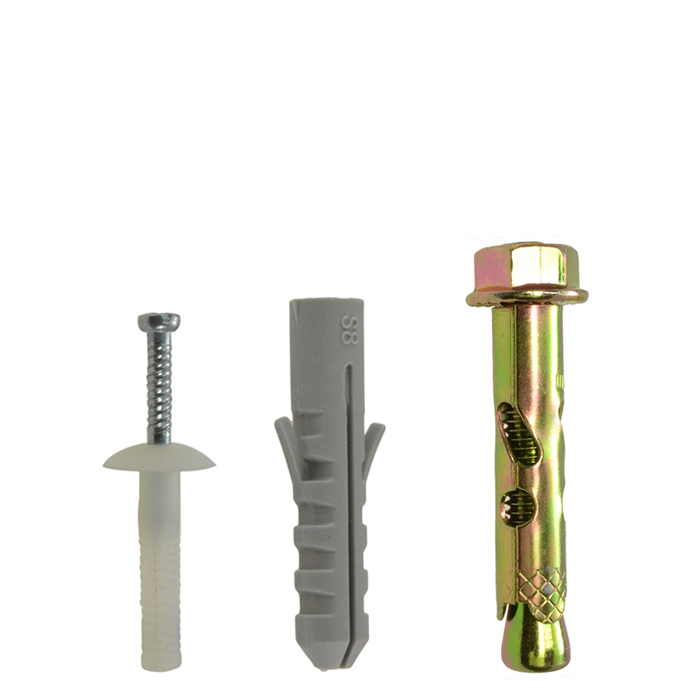
Wedge anchors (Trubolts): the workshop default for solid concrete fastening. A threaded stud with a tapered cone at the bottom and a sliding wedge clip - tightening the nut pulls the cone up into the wedge clip, locking the anchor into the hole. Single hole, no setting tool. M6 through M20.
Screw anchors (Xbolt, Bremick screwbolts): the modern alternative to wedge anchors. The screw cuts its own thread directly in the concrete or brick. Removable for rework, no protruding stud, lower torque to install. Available in Hex Flange, Countersunk, Dome Torx and Eye heads.
Sleeve anchors: a threaded bolt running through a long expansion sleeve. The sleeve expands against the hole wall when the bolt is tightened. Suit brick, hollow block and stone substrates where wedge anchors may crack the substrate.
Drop-in anchors: a flush-set internal-thread anchor for ceiling-mounted fixtures. The anchor sits flush with the substrate surface; a drop-in setting tool expands the cone wedge; the load fastener threads into the internal thread. No protruding bolt or stud.
Chemical anchors (resin studs and capsules): a threaded stud bonded to the concrete hole by a two-part polyester / epoxy resin. The strongest fastening type per anchor diameter, suited to highest-load applications (structural fixings, plant equipment, machinery tie-downs). Two-part cartridge or capsule chemistry.
Plugs and screw assemblies: nylon plug inserted into the hole; standard screw driven into the plug expands it against the hole wall. The lightest masonry fixing form - low load capacity but quick install, suited to general light-duty wall fixing.
Cavity fixings (hollow wall, toggle): for fixing into plasterboard, fibre-cement sheet, hollow block and cavity walls where there's no solid substrate behind the front face. Spring-loaded or deformable rear legs lock behind the cavity face.
MATERIALS AND COATINGS
Zinc Yellow (Class 4): the BNA-standard masonry-anchor finish. Yellow chromate passivation over zinc plating - suitable for general interior and sheltered exterior masonry fixing. Galvanised: heavier zinc plating for exterior structural masonry fixing. Stainless A4-70 G316: marine-grade for direct coastal, pool plant and swimming pool surrounds. R1000 Silver Coating: proprietary high-corrosion-life finish (Self Tapping Concrete Screws range) rated for 1000+ salt-spray hours. Plain nylon: the plug body material - inert, doesn't corrode, suitable for any substrate where the metal screw is the load-bearer.
INSTALLATION ESSENTIALS
Every masonry fixing depends on a correctly-sized hole. Drill the hole to the manufacturer's published diameter and depth - undersized holes prevent the anchor from seating; oversized holes prevent expansion and lock-up. Use a TCT-tipped masonry drill bit in a hammer-drill or rotary hammer. After drilling, blow out the dust with compressed air or a hand blower - residual dust prevents anchor expansion and is the most common cause of pull-out failure.
Edge distance and anchor spacing matter. Anchors installed too close to the concrete edge can crack out the edge under load; anchors spaced too close together create overlapping stress zones that reduce per-anchor capacity. Published edge / spacing minimums are typically 10x anchor diameter for full WLL; reduce capacity proportionally for closer installs.
OUR RANGE
Wedge Anchors | Trubolts — the workshop default - M6 through M20 zinc yellow and galvanised wedge anchors for solid concrete fixing. Single hole, no setting tool, available with optional washers.
Sleeve Anchors — hex-head sleeve anchors for brick, hollow block and stone where wedge anchors may crack the substrate. 6.5mm through 16mm body.
Countersunk Sleeve Anchors — flush-seat countersunk-head sleeve anchors for finishing-coat installs where the head must sit flush.
Hex Flange Screw Anchors — Xbolt zinc yellow hex flange screwbolt anchors - 45 SKUs across M5 to M16 sizes. Self-cutting concrete thread, removable, no protruding stud.
Countersunk Screw Anchors — countersunk (In-Hex 5mm) Xbolt screwbolt anchors for flush-seat installation in concrete. M6 through M12, zinc yellow.
Dome Torx Screw Anchors — dome-head Torx T30 screwbolt anchors - decorative head for visible installations, screw-thread retention in concrete.
Eye Screw Anchors — eye-head screwbolt anchors - rigging attachment point screwed directly into concrete. M8 zinc yellow.
Tie Down Screw Anchors — Allthread rod coupler screw anchors - the screwbolt anchor terminates in a female thread for downstream Allthread connection.
Self Tapping Concrete Screws — R1000 Silver coating hex flange self tapping concrete screws - cut their own thread, removable, high corrosion life. 6.5mm body.
Drop in Anchors — flush-set internal-thread anchors for ceiling and overhead fixtures. Smooth body, zinc yellow. M6 through M20.
H-IT Anchors — Iccons-pattern mushroom-head H-IT strike anchors in Stainless A4-70 G316. 5mm-8mm body. Drive-in expansion.
Suspension Anchors — suspension sleeve anchors for ceiling-suspended threaded rod and rigging. Zinc yellow. 6mm body.
Metal Pin Anchor — knock-in mushroom-head metal pin anchors for through-fixing into concrete. Zinc 5mm body.
Nylon Nail-In Anchor — zinc-pin nylon mushroom-head anchors for through-fixing batten and cladding into concrete or brick.
Chemical Adhesives — two-part chemical adhesive cartridges and Mungo mixer nozzles for resin-bonded anchor installation. Highest-load masonry fixing.
Chemical Studs & Capsules — zinc yellow chisel-point chemical anchor studs to install with chemical adhesives. M8, M10, M12 in various lengths.
Plastic Sleeves — Mungo plastic perforated sleeves for chemical-adhesive installation in hollow block and brick. Contains the resin so it bonds to the substrate.
Mungo Frame Anchors — Mungo MB-SSF nylon-plug + hex screw frame anchors for direct fixing of window and door frames into concrete or brick.
Mungo Plugs — Mungo MN general-purpose nylon expansion plugs - 28 SKUs covering 4mm through 14mm hole sizes for matching screw gauges.
Wall Plugs — grey universal nylon masonry wall plugs - the workshop default light-duty masonry fixing. 5mm through 10mm hole sizes.
Universal Screw Anchor — Wall Katt universal screw anchor - dual-mode anchor that works in solid masonry or cavity wall. Pan Phillips PH2 drive.
Hollow Wall Anchors — Hobson zinc silver hollow wall anchors for cavity wall fixing. M4 through M6. Use with matching setter tool.
Toggles — round-head spring toggle anchors for cavity wall fixing. M4 through M6 zinc yellow. Spring legs deploy behind the cavity face.
Plasterboard Plugs — Bremick zinc metal plasterboard plugs for fixing into plasterboard - self-tapping thread cuts its own hole in the board.
Packers — white plastic horseshoe window packers - dimensional shimming behind frames and joinery to set straight before fastening.
Spaghetti Roll — 5mm red PVC spaghetti roll - cut to length for use as a plug body when a stock-size plug isn't right. Custom-fit alternative to off-the-shelf plugs.
Need help choosing the right grade or size? Our Technical Resources page has specification guides and technical charts. Prices include GST and free standard delivery anywhere in Australia.
FREQUENTLY ASKED QUESTIONS
Which masonry anchor should I use - wedge, screw or chemical?
Wedge anchors are the default for general structural concrete fixing - cheap, fast, predictable WLL. Screw anchors are the modern alternative when you need to remove the fastener for rework or maintenance. Chemical anchors are the strongest per anchor diameter and the right choice for highest-load structural work (plant tie-downs, machinery, seismic restraints). For brick or block, prefer sleeve anchors or chemical anchors over wedge.
What hole size do I drill for an M10 wedge anchor?
10mm hole diameter, drill depth = anchor length plus 10-15mm clearance below the anchor tip. The hole diameter matches the anchor nominal size for wedge anchors (M10 = 10mm hole). Screw anchors typically need a slightly smaller pilot hole (M10 screwbolt = 8mm pilot) so the thread can cut into the concrete. Always check the per-SKU spec.
Why does my anchor pull out under load?
Three common causes - the hole wasn't blown clear of drilling dust (the most common cause), the hole is oversize or the wrong shape (worn drill bit cuts a tapered hole), or the anchor wasn't tightened to full expansion. Fresh drill bit, clean hole, follow the published torque spec, and pull-out becomes rare.
Can I use a wedge anchor in brick or block?
Generally no. Wedge anchors generate high expansion force in a small zone - solid concrete handles this; brick and most hollow blocks crack out. For brick and block, use sleeve anchors (spread expansion force over a longer zone) or chemical anchors (no expansion force at all, bond chemistry holds the stud). The exception is engineering brick fired to high density - check the brick spec.
Are screw anchors really removable?
Yes - back the screw out with the original drive bit and the anchor leaves a clean threaded hole. You can re-install a fresh anchor in the same hole, or fill the hole with cement mortar. The reusability is the main advantage of screw anchors over wedge - wedge anchors leave a permanent stud that has to be cut off and ground flush if removed.
How do chemical anchors work?
Two-part polyester or epoxy resin in a side-by-side cartridge. The cartridge dispenses through a static-mixer nozzle that combines the two parts as they exit. Inject into the drilled hole, push the chemical stud into the hole through the resin - the resin sets in 10-30 minutes (cartridge spec varies). Once set, the chemical bond is stronger than the surrounding concrete - the failure mode is concrete cone pull-out, not the anchor itself.
Why is the WLL of my anchor so much lower than its break load?
WLL (Working Load Limit) is typically 25% of the ultimate break load - the safety factor accounts for dynamic loading, shock loading, fatigue, and manufacturing variation. Designing to the break load is unsafe. Always design to WLL or lower; for cyclic loading or high-vibration applications, drop a further 50% from the published WLL.
What's the difference between Mungo plugs and standard wall plugs?
Mungo plugs (MN range) are engineered nylon plugs with calibrated rib geometry and screw-thread-matched expansion zones - they deliver consistent published WLL. Generic wall plugs are the same general idea at lower cost - acceptable for light-duty general use but with less consistent expansion behaviour. For load-rated applications, prefer Mungo; for light shelf and fixture mounting, generic wall plugs are fine.
How do I fix into plasterboard with no stud behind?
Use a cavity anchor (hollow wall anchor, plasterboard plug, toggle bolt, or spring toggle). The cavity anchor deforms or unfolds behind the plasterboard face so the load spreads across the back of the board. The hollow wall anchor range plus the matching setter tool is the workshop standard.
Can chemical anchors set in cold weather?
Yes but with longer cure time. Most cartridge resins cure in 10-20 minutes at 20-25°C; cure time doubles at 5-10°C and quadruples below 5°C. Below freezing, most resins won't cure at all - the cartridge has a published minimum installation temperature. For cold-weather work, warm the cartridge and the substrate before installation.
Why do I need a setter tool for drop-in and hollow wall anchors?
These anchors need to be expanded after installation to develop their grip. A drop-in anchor needs the cone wedge driven up with the setter; a hollow wall anchor needs the rear legs pulled in with the setter mandrel. Trying to set them without the matching tool either under-expands (pull-out failure) or damages the anchor.
Where do I find hole size and torque data for the full range?
Per-SKU data sheets are on every product page - drill diameter, drill depth, installation torque, edge distance and WLL. For an overview chart across the masonry-fixing range see Technical Resources.
WHY AUSTRALIA TRUSTS BOLT & NUT
With 15+ years selling fasteners online from Brisbane, we hold over 25,000 stock lines and 200 million pieces - 98.75% of online orders placed before 1pm leave same day. Save more as you buy more - we offer up to 13 price breaks plus 3 spend-tier discounts. Read our customer reviews or get in touch if you need help picking the right masonry anchor.
-
Accessories -
Bremick MultiONE® -
Chemical Adhesives -
Chemical Studs & Capsules -
Countersunk Screw Anchors -
Countersunk Sleeve Anchors -
Dome Torx Screw Anchors -
Drop in Anchors -
ETA Approved Anchors -
Eye Screw Anchors -
H-IT Anchors -
Hex Flange Screw Anchors -
Hollow Wall Anchors -
Masonry Drill Bits -
Metal Pin Anchor -
Mungo Frame Anchors -
Mungo Plugs -
Nylon Nail-In Anchor -
Packers -
Plasterboard Plugs -
Plastic Sleeves -
Self Tapping Concrete Screws -
Sleeve Anchors -
Spaghetti Roll -
Suspension Anchors -
Tie Down Screw Anchors -
Toggles -
Universal Screw Anchor -
Wall Plugs -
Wedge Anchors | Trubolts
Masonry anchors and fixings for concrete, brick, blockwork and stone - wedge anchors, screw anchors, sleeve anchors, drop-in anchors, chemical studs, Mungo frame anchors, plugs and cavity fixings. Same-day Brisbane dispatch.


