Machine Screws

Compare your fastener to our visual size guide to confirm M-size, pitch and length.
Match your driver bit to the screw recess - Phillips, Pozi, slot or internal hex. Our Driving range lists the bit size for every drive type we stock.
Machine Screws for Electronics, Instruments and Light Assembly
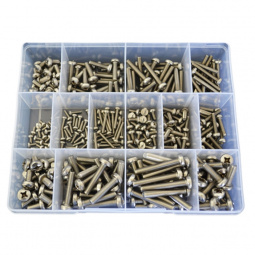
Machine screws are the fasteners that hold the small precision world together — instrument panels, electronics enclosures, light fixtures, equipment covers, brackets and any joint where you're threading into a tapped hole or pairing with a nut and washer. We stock button, cheese, countersunk, mushroom, pan, raised, round and wing head profiles in zinc plated, black zinc, A2 and A4 stainless, brass and nylon, in metric, BA, imperial and BSW thread systems from M1.6 up to M10. Most lines ship same day from our Brisbane warehouse.
Check our reviews from DIYers, tradespeople, builders, manufacturers, government, councils, engineers across Australia.
CHOOSING THE RIGHT HEAD STYLE
Each head style trades off bearing area, visual finish and how the screw sits in the surface.
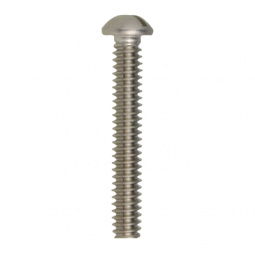
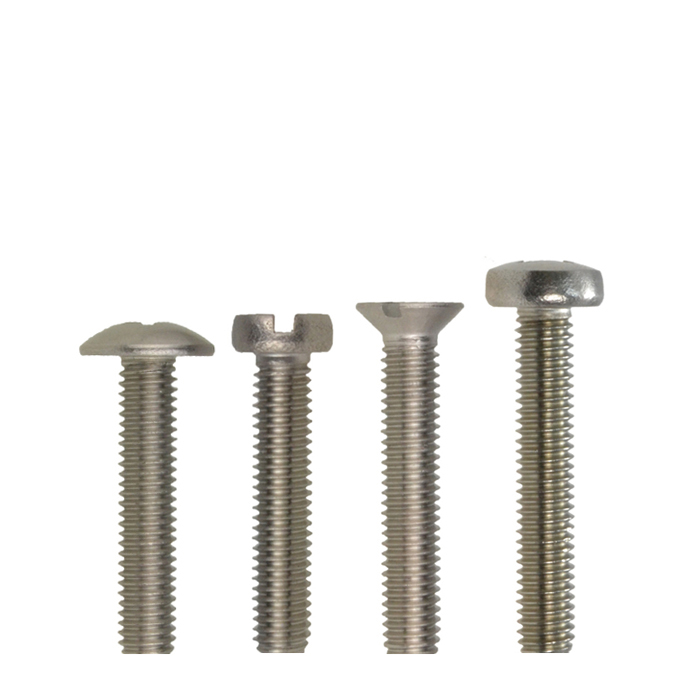
Button Head — Wide low-domed head, softer profile than pan head with similar bearing area.
Cheese Head — Tall narrow cylindrical head with a flat top. Slotted drive heritage; clean industrial look.
Countersunk Head — Flat-faced tapered head that sits flush with or below the surface in a countersunk hole. Use when the screw must not protrude.
Mushroom Head — Low rounded head with a wide bearing face for a smooth contoured finish.
Pan Head — The workhorse. Wide, slightly domed head with a flat bearing face. Most versatile for general assembly.
Raised Head — Hybrid between countersunk and round head; partial countersink with a domed top for a softer finish.
Round Head — Domed upper surface, flat bearing underface. Classic profile for traditional fixtures.
Wing Head — Two flat wings extending from the head; tighten and loosen by hand, no tools.
MATERIALS AND COATINGS
Choose by environment and required strength.
Zinc Plated — Bright silver finish, internal use only. The most economical option for dry, protected environments.
Black Zinc Plated — Electroplated zinc with a black chromate dip for a darker finish. Some minor inconsistency in finish depth is normal with this process.
A2-70 G304 Stainless Steel — The most popular stainless grade. Suitable for most external Australian environments. largely non-magnetic — A small degree of magnetism from work-hardening during manufacture is normal.
A4-70 G316 Marine Grade Stainless — The correct choice for anything within 300 metres of the coast or exposed to salt spray.
Brass — Excellent thermal conductivity, corrosion resistance and aesthetic appeal. Used in plumbing, marine and heritage / decorative applications.
Nylon — Non-conductive, chemically resistant, lightweight. Used in electronics where insulation matters; absorbs some moisture from the environment which can reduce tensile strength over time.
DRIVE TYPES
We stock three drive options across the machine screw range:
Phillips (PH1 / PH2) — Cross-recess drive, the default for power-driven assembly. Lower cam-out risk than slotted.
Phillips / Slotted Combination — Accepts both a Phillips driver and a flat-blade screwdriver. Practical when the assembler's tool isn't guaranteed.
Slotted — Single straight slot for a flat-blade screwdriver. Traditional drive on cheese, round and raised-head screws; the right choice for restoration and heritage work.
THREAD SYSTEMS
Four thread systems are stocked across the range:
Metric Coarse — M1.6 through M10. The Australian default.
British Association (BA) — 0BA to 10BA. Found in older British and Australian instruments, valve work and model engineering.
Imperial (UNC / UNF) — North American thread systems from #0–#12 and 3/16" to 5/16". Common in imported equipment.
BSW (British Standard Whitworth) — Original British coarse thread, still used in heritage and restoration work.
UNDERSTANDING THREAD PITCH
Thread pitch (metric) is the distance between the peaks of two adjacent threads, expressed in millimetres. A thread pitch of 1.50mm means adjacent threads are 1.50mm apart. All our metric machine screws use standard metric coarse pitch unless otherwise specified.
Imperial sizes are measured in TPI (threads per inch). To identify the TPI of an unknown machine screw, measure 1" (25.4mm) along the threads with a ruler and count how many thread peaks fall within that span — that number is the TPI. On smaller machine screws the threads can be hard to count by eye — use a pen or thin drill bit to step from one thread to the next as you count, and a torch (or your phone light) for better visibility.
HOW FASTENER LENGTH IS MEASURED
For pan, round, wing, button, mushroom and cheese head machine screws, length is measured from under the bearing surface to the tip — The head is not part of the length. For countersunk and raised head screws, length includes the head because the head sinks into the surface, so length is measured from the top of the head to the tip.
OUR RANGE
Button Head Machine Screws — Wide low-domed head with a flat bearing face. A softer alternative to pan head where appearance matters.
Cheese Head Machine Screws — Tall narrow cylindrical head with slot or Phillips drive. Industrial heritage look, common in valve and instrument work.
Countersunk Head Machine Screws — Flush-fitting tapered head that sits at or below the surface. For panels, brackets and any application where the screw must not protrude.
Mushroom Head Machine Screws — Soft low rounded head with a wide bearing face. Used where a smooth contoured finish is preferred over a sharp head edge.
Pan Head Machine Screws — The workhorse — wide slightly domed head, the most versatile profile for general assembly, electronics and appliances.
Pan Head Sems — Pan head screw with a pre-assembled spring or flat washer captive under the head. Saves time and ensures the washer is never forgotten.
Raised Head Machine Screws — Countersunk-with-a-dome hybrid. Sits part-way into the surface with a softly rounded top for a finished look.
Round Head Machine Screws — Classic domed head with flat bearing underface. Traditional profile, often paired with imperial BA threads.
Thread Rolling Screws — Form their own mating thread as they're driven into a soft material — no pre-tapping required. Used in sheet metal and plastics.
Wing Head Machine Screws — Thumbscrews — hand-tighten without tools. For access panels, covers and equipment that needs frequent opening.
FREQUENTLY ASKED QUESTIONS
Can stainless fasteners be used with aluminium?
Yes — and for most applications, no special precautions are needed. The combination is widely used in industries where strength and corrosion resistance matter (marine, automotive, structural aluminium). For applications with sustained moisture or salt exposure, a few simple steps (barrier washer, sealant, matched-anodising) prevent any long-term galvanic corrosion concerns. Full guidance: Can stainless fasteners be used with aluminium?
What's the difference between a machine screw and a self-tapping screw?
A machine screw has a fully-threaded shank designed to mate with a pre-tapped hole (or a nut and washer) — it doesn't cut its own thread. A self-tapping screw has a hardened body and a thread profile designed to cut its own thread as it's driven into untapped material (sheet metal, plastic). Machine screws need a pre-tapped hole; self-tappers don't.
How do I know what thread system my equipment uses?
Check the equipment's documentation if you can. For Australian-made gear after roughly 1970, expect Metric Coarse. For older British or Australian equipment, BSW/BSF or BA threads are likely. For imported American equipment, UNC or UNF. As a quick visual test, metric and imperial threads have different pitch counts per a measured length — count threads over a known span and consult a thread pitch chart.
When should I use Phillips vs slotted drive?
Phillips is the modern default — it self-centres on the screwdriver, takes higher torque, and is faster for power-driven assembly. Slotted is the traditional choice — kept for restoration work where authentic appearance matters, for thin-profile cheese and round-head fasteners, and for any application where someone might want to drive the screw with a coin or makeshift tool. Phillips/slotted combination drives accept either.
What's the difference between pan, round, cheese, button and mushroom heads?
Pan head is the modern default — wide, slightly domed, flat bearing face. Round head has a fully-domed top — older traditional profile, common in BA threads. Cheese head is tall and cylindrical with a flat top — slotted-drive industrial heritage. Button head is a wide low dome — softer profile than pan. Mushroom head sits between button and round — low and wide. The choice is part visual, part bearing area, part clearance.
Are machine screws available in nylon?
Yes — nylon machine screws are stocked for applications where electrical insulation, chemical resistance, low weight or non-conductivity matters. Pan head and countersunk are the common nylon profiles. Note that nylon is hygroscopic (absorbs moisture from air), which can slightly reduce tensile strength over time in wet environments, and they shouldn't be used where high mechanical clamp load is needed.
What's a wing head machine screw and when is it useful?
A wing head (thumbscrew) has two flat wings extending from the head, allowing the fastener to be tightened and loosened by hand without tools. Used on access panels, instrument covers, equipment housings, and anywhere a service technician needs to open a unit frequently and quickly without reaching for a screwdriver.
What's the difference between Phillips and Pozi drive?
Phillips (PH) has a cross with tapered tips designed to cam out under high torque — a safety feature in 1930s manufacturing. Pozidriv (PZ) has the same cross plus four extra ribs that engage the screw firmly and resist cam-out, allowing higher driving torque. They look similar but are not interchangeable — using a PH driver on a PZ screw will damage the recess. Check the recess for the four extra marks to identify a Pozi.
Can I use a machine screw in timber?
No — machine screws have a machine thread designed to mate with a tapped hole or matching nut, not to cut their own thread into a substrate. The thread profile is fine and uniform, with no self-cutting tip. For timber, use a timber screw (chipboard, decking, batten) that has a coarse self-cutting thread and a sharp tip. Machine screws can be used through a tapped insert in timber if you want a removable threaded fixing.
What thread size are imperial #4, #6, #8, #10 machine screws?
Imperial numbered sizes are US (Unified) thread sizes, used as diameter codes — #4 is 0.112" (2.84mm), #6 is 0.138" (3.5mm), #8 is 0.164" (4.17mm), #10 is 0.190" (4.83mm), #12 is 0.216" (5.49mm). They typically come in UNC or UNF threads (e.g. #10-24 UNC has 24 threads per inch coarse; #10-32 UNF has 32 TPI fine). Above #12 the sizing switches to fractional inches (1/4", 5/16", etc).
Why would I choose a countersunk (CSK) machine screw over a pan or button head?
A countersunk head sits completely flush with the work surface — essential where any protrusion would interfere with adjacent parts (sliding panels, hinges, machined surfaces). The matching countersunk hole carries some of the clamp load through the cone profile. Pan and button heads sit proud of the surface and are easier to drive but won't sit flush.
What's the strongest grade of machine screw available?
For metric, the highest commonly-stocked grade is Class 8.8 in plain black or zinc, with Class 10.9 available on larger sizes. For imperial, Grade 5 and Grade 8 SAE high-tensile screws are available in UNC and UNF. For stainless, A2-70 G304 (~700 MPa) and A4-80 G316 (~800 MPa, marine grade). Most machine screw applications don't need high-tensile grades — they're load-bearing in shear or low-tension clamp.
WHY AUSTRALIA TRUSTS BOLT & NUT
With 15+ years selling fasteners online from Brisbane, we hold over 25,000 stock lines and 200 million pieces — 98.75% of online orders placed before 1pm leave same day. Save more as you buy more — we offer up to 13 price breaks plus 3 spend-tier discounts. Read our customer reviews or get in touch if you need help picking the right machine screw.
-
Button Flange Head -
Button Head -
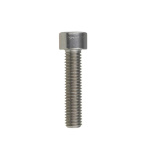
Cap Head -
Cheese Head -
Countersunk Head -
Mushroom Head -
Pan Head -
Raised Head -
Round Head
-
Sems -
Thread Rolling Screws -
Wing Head
Find the right machine screws for your project at Bolt & Nut Australia. We stock hundreds of machine screws online — pan head, countersunk, raised CSK and round head in Phillips and slotted drives. Available in stainless A2-70 G304 and A4-70 G316 marine, zinc plate and brass. Order online for same-day Brisbane dispatch and free delivery Australia-wide.
TECHNICAL RESOURCES
Every machine screw subcategory has its own CAD drawings and spec PDFs linked at the bottom of its page. For the full library covering machine screws and every other product range we stock, see our Technical PDF's Library.