Self Tapping Screws

Self Tapping Screws for Metal, Plastic, Thin-Sheet and Timber Fastening
Self tapping screws cut their own thread as they're driven into the substrate — no pre-threaded hole needed. The hardened thread profile shapes the receiving material as it advances, forming a tight mechanical thread that resists pull-out and vibration.
Used wherever you need to fasten into sheet metal, plastic, thin steel, panel substrates or timber without the time and cost of tapping a thread beforehand. While not purpose-built for timber (see our screws for timber range for that), self-tapping screws hold well in softwoods and MDF for light-duty applications such as cabinetry, trim, signage backing and panel fixing.
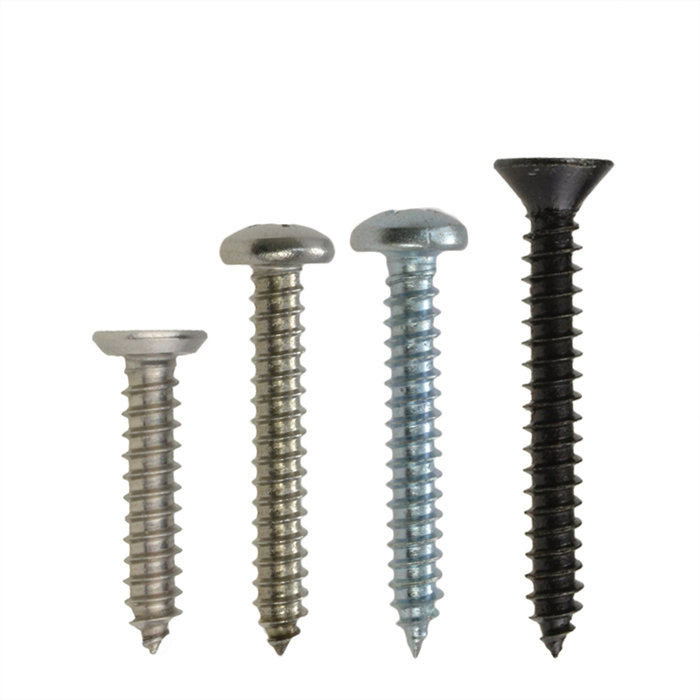
We stock 750+ self-tapping screw variants from our Brisbane warehouse across four head styles — pan, button, countersunk and mushroom — with eight drive types, four material grades and gauges from 2g to 14g. Specialised Plastite (Hi-Plas) thread-forming screws for plastic substrates are also stocked. Suitable for general fabrication, panel work, sheet metal assembly, electronics enclosures, signage, automotive trim and security-sensitive installations (Post-Torx, Eye Drive and One Way head options).
Check our reviews from DIY, tradespeople, builders, manufacturers, government, councils and engineers across Australia.
MATERIALS AND COATINGS
Stainless steel A2-70 G304 — Standard 18/8 austenitic stainless. Corrosion-resistant in general indoor and mild outdoor environments. The default choice for outdoor or food-grade work where chloride exposure is limited. Ultimate tensile 700 MPa minimum, non-magnetic in annealed condition (very slightly magnetic after cold-working — see our stainless magnetism FAQ).
Stainless steel A4-70 G316 — Marine-grade molybdenum-bearing stainless. Same 700 MPa minimum tensile as A2-70, but the added molybdenum gives substantially better resistance to chlorides and salt spray. The right choice for coastal, marine, pool and treated-timber applications.
Zinc plated (silver) — Case-hardened carbon steel with an electroplated zinc layer. The everyday cost-effective option for interior or dry-environment fastening into sheet metal, plastic and softwood. Not suitable for outdoor or wet exposure.
Black zinc plated — Case-hardened carbon steel with a black zinc finish for cosmetic or low-reflectance applications (signage, electronics enclosures, photographic equipment). Same indoor-only corrosion profile as silver zinc.
Wax-coated zinc (Plastite) — Hardened steel with zinc plating plus a wax overlay that reduces drive torque when forming threads in plastic. Specific to our Plastite thread-forming range.
CLASSES AND GRADES
A2-70 G304 — Ultimate tensile 700 MPa minimum. The standard stainless self-tapper grade for general corrosion-resistant fastening.
A4-70 G316 — Ultimate tensile 700 MPa minimum, with molybdenum for chloride resistance. Used where the environment is marine, coastal, swimming-pool or treated-timber.
Hardened steel (case-hardened carbon) — The thread is case-hardened so it can cut a mating thread into mild steel sheet, panel and plastic. Surface hardness around HRC 45-55 with a softer ductile core. Sold with zinc or black zinc plating.
HEAD STYLES
Pan head — Slightly domed top with a flat underside. The most versatile head style — sits proud above the surface with a wider load-spreading footprint than countersunk. Used in sheet metal assembly, signage and general panel work.
Button head — Lower-profile dome with a smaller diameter than pan. Cleaner finish where a flush appearance matters but flush countersinking isn't possible.
Countersunk head — 82-degree conical underside that sits flush with the substrate when seated in a countersunk hole. Used in trim, cladding, casework and any application where the head must not stand proud.
Mushroom (flange) head — Low-domed top with an integral flange. The flange spreads load over a larger area than a pan head — useful for thin sheet metal, plastic and weather-strip retention where pull-through is a concern.
DRIVE TYPES
Phillips — The default drive across most of our self-tapper range. Available in PH1, PH2 and PH3 depending on gauge. Driver bits available in our Phillips bits range.
Pozi — Used on our Plastite range. Provides better torque transmission than Phillips under high installation loads. Driver bits available in our Pozi bits range.
Post (Pin) Torx — Security drive with a pin in the centre of the recess that blocks standard Torx bits. Requires a matching post-Torx bit (T10, T15, T20, T25, T27, T30). See our post Torx bits range.
Post (Pin) Hex — Security drive with a pin in the centre of a hex socket. Used where a slightly less specialised deterrent than Post-Torx is acceptable. See our post hex bits.
Eye Drive / Snake Eye — Two-pin spanner-style security drive. Requires the matching snake eye bit — almost no public access to these bits, so the install stays tamper-resistant.
One Way — Slot drive shaped so a screwdriver can tighten the screw but slides off when reversed. Permanent installations only. Used where the screw must never be removable by general public — toilet partitions, public-facing fittings, signage in vandal-prone areas.
SCREW GAUGE AND TPI
Self-tappers in our range are gauge-sized (American Type AB convention) and run a single TPI per gauge. The gauge sets the body diameter at the thread; TPI sets the thread count per inch of length. The table below shows the gauges, TPI and metric equivalents that Bolt & Nut Australia stocks for Self Tapping Screws:
| Gauge | TPI | Body diameter (metric) | Decimal inch |
|---|---|---|---|
| 2g | 32 | 2.2mm | 0.086″ |
| 4g | 24 | 2.9mm | 0.112″ |
| 6g | 20 | 3.5mm | 0.138″ |
| 8g | 18 | 4.2mm | 0.164″ |
| 10g | 16 | 4.8mm | 0.190″ |
| 12g | 14 | 5.5mm | 0.216″ |
| 14g | 14 | 6.3mm | 0.250″ |
Lengths run from 6mm to 100mm depending on gauge and head style. Specialised Plastite thread-forming screws use metric M sizes (M2.5 through M6) because their thread profile is engineered for plastic boss diameters rather than general sheet-metal use.
STANDARDS
AB ANSI B18.6.4 / DIN 7982C / ISO 7050 — Type AB (gimlet point) self-tapping screw standard. The international equivalents are interchangeable in practice. This covers the majority of our pan, button, countersunk and mushroom range.
DIN 7500 — Thread-forming screw standard for plastic and light metal. Specific to our Plastite range.
HEC Standard and Sentinel Standard — Manufacturer specifications used on the security drives (Post Torx, Eye Drive, One Way) where no public ISO/DIN equivalent exists.
OUR RANGE
Pan & button head self tappers — The everyday-use gauge-sized self-tappers (2g to 14g) in Phillips, security and one-way drives, A2-70, A4-70, silver zinc and black zinc. 335 variants.
Countersunk head self tappers — Flush-finish self-tappers (2g to 14g) for trim, cladding, casework and signage. Phillips plus security drives (Post Torx, Eye Drive, Post Hex). 328 variants.
Plastite screws (thread-forming for plastic) — Specialised thread-forming screws (M2.5 to M6) for engineering plastics — the trilobular thread shape rolls a tight thread into the boss without removing material. 74 variants.
Mushroom head self tappers — Low-profile flanged-head self-tappers (6g, 8g, 10g) in black zinc for sheet-metal panel fixing where pull-through resistance is critical. 15 variants.
TECHNICAL RESOURCES
Every self-tapper subcategory has its own CAD drawings and spec PDFs linked at the bottom of its page. For the full library covering self-tappers and every other product range we stock, see our Technical PDFs library, and for torque, drill-size and load charts see the Charts and Calculators section.
FREQUENTLY ASKED QUESTIONS
Can stainless fasteners be used with aluminium?
Yes — and for most applications, no special precautions are needed. The combination is widely used in industries where strength and corrosion resistance matter (marine, automotive, structural aluminium). For applications with sustained moisture or salt exposure, a few simple steps (barrier washer, sealant, matched-anodising) prevent any long-term galvanic corrosion concerns. Full guidance: Can stainless fasteners be used with aluminium?
What's the difference between a self-tapping screw and a self-drilling screw?
A self-tapping screw has a sharp thread that cuts (taps) its own thread into a pre-drilled pilot hole — you need to drill a pilot first. A self-drilling screw has a drill-point tip that cuts both the pilot hole AND the thread in one operation — no pre-drilling required. Self-drillers are faster on steel but less suitable for plastic; self-tappers give more control on thinner or softer substrates. Type AB (gimlet point) self-tappers are the standard self-tapping profile in our range.
What pilot hole size should I use?
Pilot hole size depends on the screw gauge and the substrate. For softwoods (pine, MDF) drill ~70% of the screw's outer diameter; for hardwoods (jarrah, merbau) ~85%; for sheet metal up to 1.5mm pilot at the body diameter; for steel plate (1.5mm+) pilot at ~85% of the body diameter; for plastic ~90% to avoid cracking. Use the table below as a starting point.
| Gauge | Body diameter | Softwood (Pine, MDF) | Hardwood (Jarrah, Merbau) | Sheet metal ≤1.5mm | Steel 1.5–3mm | Plastic |
|---|---|---|---|---|---|---|
| 4g | 2.9 mm | 2.0 mm | 2.4 mm | 2.5 mm | 2.6 mm | 2.6 mm |
| 6g | 3.5 mm | 2.5 mm | 3.0 mm | 3.0 mm | 3.2 mm | 3.2 mm |
| 8g | 4.2 mm | 3.0 mm | 3.5 mm | 3.6 mm | 3.8 mm | 3.8 mm |
| 10g | 4.8 mm | 3.5 mm | 4.0 mm | 4.2 mm | 4.3 mm | 4.4 mm |
| 12g | 5.5 mm | 4.0 mm | 4.7 mm | 4.8 mm | 5.0 mm | 5.0 mm |
| 14g | 6.3 mm | 4.5 mm | 5.5 mm | 5.5 mm | 5.7 mm | 5.7 mm |
Sizes are general guidance for thread-cutting self-tappers. For Plastite (thread-forming) screws and very brittle plastics, always use the manufacturer's recommended boss diameter — see the Plastite subcategory page for details. For dense hardwoods and pre-drilling steel, drill a clearance hole through the top piece (body diameter) and pilot only the substrate it threads into.
What does '10g' mean on a self-tapping screw?
The 'g' is the American gauge number for the screw's body diameter. It comes from the older imperial wire-gauge system but maps cleanly to a metric body diameter: 2g = 2.2mm, 4g = 2.9mm, 6g = 3.5mm, 8g = 4.2mm, 10g = 4.8mm, 12g = 5.5mm, 14g = 6.3mm. Length is given separately (in millimetres or inches). So '10g x 25mm' means a screw with a 4.8mm shank that's 25mm long under the head.
Can self-tapping screws be used outdoors?
A2-70 G304 and A4-70 G316 stainless — yes, suitable for outdoor use. A4-70 is the better choice for coastal, marine or treated-timber exposure because the molybdenum content gives it much better chloride resistance. Hardened steel with zinc plating (silver or black zinc) — INTERNAL USE ONLY. The zinc layer is thin and the steel core will rust within months if exposed to moisture. For treated-timber contact, prefer A4-70 G316 over zinc.
What's the difference between Phillips and Pozi drives?
Phillips (cross slot) is designed to slip out (cam-out) at a specific torque to prevent over-tightening — useful on assembly lines but frustrating when you actually want the screw fully seated. Pozi (cross slot with extra ribs) is engineered to stay engaged under high torque without cam-out, giving better control on harder substrates. Our Plastite range uses Pozi because thread-forming in plastic needs sustained torque control.
Why use a Post (Pin) Torx or Eye Drive self-tapper?
Security. Standard Torx and slot drives can be removed by anyone with a basic bit set; post-Torx and Eye Drive (snake eye) require specialised bits that aren't widely available in retail. Used on vandal-prone fittings, public-facing signage, toilet partitions, marine equipment access panels, and any installation where you want to discourage casual tampering. The drive doesn't prevent a determined attacker but eliminates 95% of opportunistic removal.
Can self-tapping screws fasten into plastic?
Yes — but match the screw type to the plastic. For softer plastics (polyethylene, polypropylene, ABS) a standard Type AB self-tapper works if the pilot hole is properly sized. For engineering plastics (acetal, nylon, polycarbonate, PBT) and any thin-walled plastic boss, use our Plastite thread-forming screws — the trilobular thread shape rolls a thread into the plastic without removing material, which prevents cracking and gives a much stronger holding force. Always pilot at ~90% of the screw body diameter for plastic, and avoid over-tightening once seated.
Can self-tapping screws be used in timber?
Yes — self-tapping screws hold well in softwoods, MDF, particleboard and similar timber substrates for light-to-medium duty work such as cabinetry, trim, panel fixing, signage backing and general joinery. They are not purpose-built for timber though: the thread profile is optimised for sheet metal, plastic and thin steel rather than for cutting cleanly through dense wood fibres. For structural timber work, decking, cladding, framing or fixing into hardwoods like jarrah and merbau, use a dedicated timber screw (Type 17 self-drilling tip, deeper coarse thread) — these cut faster, pull down harder, and resist pull-out under load. For decking specifically see our decking screws. Always pilot hole hardwoods to prevent splitting — see the pilot hole table above.
Are self-tappers available in metric thread?
Our standard self-tapper range uses gauge sizing (2g to 14g) rather than metric threads because the screw forms its own thread — there's no mating thread to match. Our Plastite range uses metric M sizes (M2.5 to M6) because those are matched to plastic boss diameter standards (DIN 7500), not because they cut a metric machine-screw thread.
What standard are your self-tapping screws made to?
Our Type AB pan, button, countersunk and mushroom self-tappers are manufactured to AB ANSI B18.6.4, which is interchangeable with DIN 7982C and ISO 7050 (international equivalents of the same gimlet-point geometry). Plastite thread-forming screws follow DIN 7500. Security drives (Post Torx, Eye Drive, One Way) follow manufacturer specifications (HEC, Sentinel) where no public ISO/DIN equivalent exists.
WHY AUSTRALIA TRUSTS BOLT & NUT
Buy with confidence: 13+ years experience selling online, > 25,000 stock lines, 200 million pieces ex stock in Brisbane QLD
Prices: Includes GST, a Tax Invoice and Free Standard Delivery anywhere in Australia
Up to 13 price breaks and 3 levels of spend discounts available on every product.
98.75% of orders placed before 1pm leave our Brisbane warehouse the same day.
Read what our customers say — reviews from DIY, tradespeople, builders, manufacturers, government, councils and engineers across Australia.
-
Countersunk Head -
Mushroom Head -
Pan & Button Head -
Plastite Screws
Find the right self tapping screws for your project at Bolt & Nut Australia. We stock 750+ self-tappers online — pan, button, countersunk and mushroom head profiles in Phillips, Pozi, Post-Torx, Post-Hex, Eye Drive and One Way security drives. Available in A2-70 G304 stainless, A4-70 G316 marine stainless, zinc plated, black zinc and hardened steel. Gauges 2g through 14g. Order online for same-day Brisbane dispatch and free delivery Australia-wide.


