Header imageFREE Delivery Header imageAustralian OwnedHeader imageSpend DISCOUNTS

Nuts

Nuts
Not sure what nut you have?
Two ways to identify it - whichever is easier with what is in front of you.
1If you have the nut

Find the spanner that fits it snugly, then measure the hole. Our nut identification chart lists every metric and imperial nut we stock side by side, sorted by spanner size.

Open the nut identification chart ›

2If you have its bolt

The fastest check is the male thread: the right nut spins onto its bolt by hand with no force. Identify the bolt size and pitch first with our bolt and screw guide, and the nut follows.

Open the bolt and screw guide ›

Nuts for Mechanical, Structural and General Fastening

Nuts are the mating half of every threaded fastener — the component that gives a bolt, screw, stud or threaded rod its clamp. We stock 1,248+ nut variants across 29 subcategories from our Brisbane warehouse, with same-day shipping on stocked lines. Metric (coarse, fine, left-hand), UNC, UNF, BSW, BSF and ACME thread systems; classes from low-tensile 4.6 up to high-tensile 12; A2-70 G304 and A4-70 G316 stainless; galvanised, zinc plate, zinc yellow, brass, nylon and chrome finishes.

Check our reviews from DIYers, tradespeople, builders, manufacturers, government, councils, engineers across Australia.

MATERIALS AND COATINGS

Choose by environment, required strength and finish.

Stainless Steel — Corrosion resistance for external and wet environments. A2-70 G304 for general use, A4-70 G316 for marine and coastal. Largely non-magnetic.

Zinc Silver Plated — Bright silver electroplated finish. Internal use only — the default for protected indoor environments.

Galvanised — Hot-dip zinc coating. Thicker than zinc plate; the right choice for outdoor and treated-timber work.

Zinc Yellow Plated — Yellow chromate finish. Used on cage nuts, timber insert nuts and select flange nyloc nuts.

Plain Black Uncoated — Bare uncoated carbon steel. Used on high-tensile structural nuts, plow nuts and ACME nuts where the customer applies their own finish.

Brass — Corrosion resistant, non-sparking, decorative. Specialist marine, plumbing, electronic and heritage work.

Nylon — Non-conductive, lightweight, chemically resistant. Specialist use in electronics and isolating assemblies.

Chrome Plated — Decorative bright finish on dome and cap nuts where appearance matters.

Polyethylene (PE) — Flexible plastic for snap-on bolt-head plug covers.

CLASSES AND GRADES

Australian and international tensile grades stocked across the nut range.

High Tensile Class 8 — The workhorse high-tensile metric nut grade. Mate for Class 8.8 bolts.

High Tensile Class 10 — Higher proof load. For mating with Class 10.9 bolts and high-stress joints.

High Tensile Class 12 — Premium high tensile. Used on flange and conelock nuts where high clamp load is required in a compact form.

Low Tensile Class 4.6 / Class 5 — Economical mild-steel grades for general fastening. Coach nuts, channel nuts, decorative work.

A2-70 G304 Stainless Steel — The standard stainless grade. Suitable for most external Australian environments.

A4-70 G316 Marine Grade Stainless — For marine, coastal and chemical exposure. Use within 300 metres of the coast.

Imperial Grades 2, 5 and 8 — High-tensile imperial classes for UNC/UNF/BSW threads. Grade 8 is the highest, found on plow nuts.

THREAD SYSTEMS

Six thread systems stocked across the nut range.

Metric Coarse — The Australian default. M2 through M72.

Metric Fine — Fine-pitch metric, used in automotive and precision work.

Metric Coarse Left-Hand Thread — Reverse-thread metric coarse for applications where right-hand rotation would loosen the fastener.

Unified Coarse (UNC) and BSW Coarse — Imperial coarse threads. UNC is the modern North American system, BSW the older British standard.

Unified Fine (UNF) and BSF Fine — Fine-pitch imperial. Used where finer clamp control is needed.

BA (British Association) — Small-diameter precision threads used in heritage instruments and electronics.

ACME — Trapezoidal-profile thread for linear motion and power transmission (lead screws, clamps, jacks).

UNDERSTANDING THREAD PITCH

Thread pitch (metric) is the distance between the peaks of two adjacent threads, expressed in millimetres. A thread pitch of 1.50mm means adjacent threads are 1.50mm apart. All our metric nuts use standard metric coarse pitch unless otherwise specified.

Imperial sizes are measured in TPI (threads per inch). To identify the TPI of an unknown nut, measure 1" (25.4mm) along the threads with a ruler and count how many thread peaks fall within that span — that number is the TPI. On smaller nuts the threads can be hard to count by eye — use a pen or thin drill bit to step from one thread to the next as you count, and a torch (or your phone light) for better visibility.

NUT STYLES

Eight broad nut-body styles across the range.

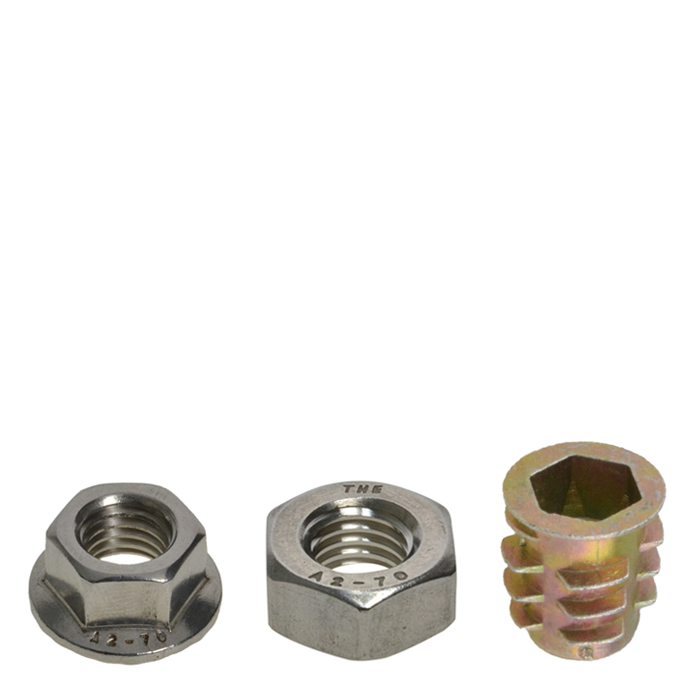
Hex (Six-Sided) — The default profile, driven with a spanner or socket. Standard, thin, flange, dome, cap and acorn variants all use a hex body.

Square — Four-sided body. Wider spanner contact than hex, used in heritage and channel applications.

Flange — Hex body with an integrated washer face. Serrated variants resist back-off.

Wing — Two flat wings for hand tightening.

Cap, Dome and Acorn — Closed-top decorative profiles covering the bolt end.

Tee, Cross Dowel and Insert — Captive nuts for timber, joinery and panel work.

Cage and Channel — Captive nuts that hold their position in panels and slotted strut.

Coupling (Rod Coupler) — Extended hex nut for joining two male threads end-to-end.

OUR RANGE

Hex Standard Nut — The default nut — six-sided, internally threaded. Metric M3-M48 and imperial 1/8"-2" in low/high tensile carbon steel, A2-70 G304, A4-70 G316 stainless, brass and nylon.

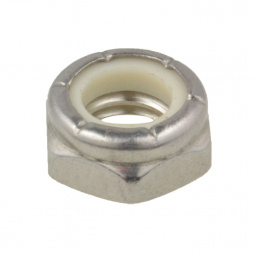
Nyloc Insert Nut — Hex nuts with a nylon insert that locks against vibration. Metric M3-M30 and imperial, in zinc, galvanised, A2-70 G304 and A4-70 G316. DIN 985, IFI-100NE.

Dome Nut — Closed-top decorative nuts that cover the protruding end of a bolt or stud. Stainless A2-70 G304, A4-70 G316, chrome and brass. DIN 1587.

Lock Nut Thin — Thin (half-height) jam nuts used in pairs with a standard nut to mechanically lock against vibration. Stainless A2-70 G304, A4-70 G316, galvanised and zinc.

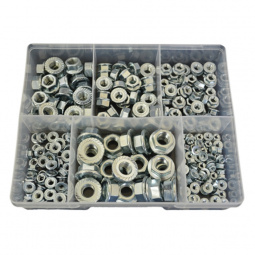
Flange Nut — Hex nut with a built-in washer flange — serrated variants resist back-off without needing a separate washer. Zinc, stainless and galvanised. DIN 6923.

Wing Nut — Hand-tightenable nuts with two flat wings for finger grip. Stainless A2-70 G304, A4-70 G316, zinc and brass. Metric and imperial.

Channel Nut — Rectangular spring-loaded nuts for slotted channel and strut systems. Zinc and galvanised, M6 to M16, Class 4.6 carbon steel and A4-70 G316.

Conelock Nut — All-metal prevailing-torque locking nuts with a conical distorted top. Zinc Class 10 and Grade C. DIN 980 and IFI100-107.

Cage Nut — Captive nuts in a sprung cage — snap into square panel holes. Zinc yellow Class 4.6 and A2-70 G304 stainless. M4-M12 and imperial.

Hex Rod Coupler Nut — Extended hex nuts for joining two male threads (e.g. threaded rod). Zinc Class 5 and A4-70 G316 stainless. DIN 6334.

Barrel Nut — Flat-headed cylindrical nuts for furniture and joinery — JCB connector style. Stainless A2-70 G304, A4-70 G316 and nickel. Socket, post-Torx and Phillips drives.

Flange Nyloc Insert Nut — Flange nuts with a captive nylon vibration ring — wider clamp area than a standard Nyloc. Zinc Class 10 and A2-70 G304. DIN 6926.

Tee Nut — Pronged flanged nuts that anchor into timber from one side. Zinc and stainless A2-70 G304. DIN 1624.

All Metal Lock Nut — All-metal prevailing-torque lock nuts — no nylon, suits high-temp applications. A2-70 G304 and A4-70 G316 stainless. DIN 980.

Left Hand Thread Nut — Reverse-thread (LHT) hex nuts. A2-70 G304 and A4-70 G316 stainless, M4-M20 metric coarse. DIN 934.

Shear Security Nut — Shear-off security nuts — break to a smooth cone at preset torque. Stainless A2-70 G304, A4-70 G316 and galvanised. M6-M20.

Square Nut — Four-sided chamfered nuts — wider grip surface than a hex. Galvanised Class 5 and A4-70 G316 stainless. DIN 557.

Thin Nyloc Insert Nut — Half-height Nyloc nuts for restricted clearance. Zinc Class 4 and A2-70 G304. ISO 10511.

Timber Insert Nut — Teeth or threaded inserts that bite into timber to provide a threaded socket. Zinc yellow Class 4.6. M4-M10. Internal hex drive.

Structural K0 Nut — Hot-dip galvanised structural nuts to K0 AS1252:2016. Class 8 high-tensile, M12-M36.

Hex Head Plug Cover — Polyethylene snap-on covers for hex bolt heads — corrosion and identification. M4-M24 to suit AS1110 hex bolts.

Cap Nut — Low-profile domed cap nuts — slimmer than a full dome. Stainless A2-70 G304. DIN 917.

Cross Dowel Nut — Slotted concealed cross-dowel nuts for perpendicular timber-to-timber joints. Zinc and zinc yellow Class 4.6. M6 and M8.

Slab Tee Nut — Tamper-proof slab tee threaded inserts for playgrounds and public installations. A2-70 G304 stainless. M4-M10.

Weld Nut — Hex nuts with welding projections for joining to sheet steel. A2-70 G304 stainless. DIN 929.

Acme Nut — Hex ACME-thread nuts for power transmission and linear motion (lead screws, clamps, jacks). Grade 5 high-tensile, plain black.

Plow Nut — Heavy high-tensile hex nuts to match Grade 8 plow bolts. Plain black, UNC coarse, 5/8"-1-3/8".

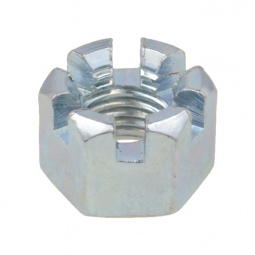
Slotted Castle Nut — Castle-top nuts with slots for split-pin retention. Zinc Class 5, metric fine M8-M24. DIN 935.

K-Lock Nut — One-piece hex nut and captive external tooth lock washer. Zinc Class 5, M5 and M6. DIN 934K.

FREQUENTLY ASKED QUESTIONS

Can stainless fasteners be used with aluminium?

Yes — and for most applications, no special precautions are needed. The combination is widely used in industries where strength and corrosion resistance matter (marine, automotive, structural aluminium). For applications with sustained moisture or salt exposure, a few simple steps (barrier washer, sealant, matched-anodising) prevent any long-term galvanic corrosion concerns. Full guidance: Can stainless fasteners be used with aluminium?

What's the difference between a Nyloc nut and an all-metal lock nut?

A Nyloc nut has a captive nylon insert in the top of the nut — friction between the nylon and the bolt threads stops the nut backing off under vibration. An all-metal lock nut uses distorted upper threads (Conelock, all-metal, K-lock) to grip the bolt mechanically with no plastic. Nyloc is the standard choice for general work; all-metal lock nuts are preferred for high-temperature, chemical-exposure or welding applications where nylon would fail.

What does Class 8 mean on a nut?

Class 8 is the most common high-tensile metric nut grade — designed to mate with Class 8.8 bolts. The proof load of the nut is engineered so the bolt fails before the nut strips. Class 10 nuts mate with Class 10.9 bolts; Class 12 with Class 12.9. Low-tensile Class 4.6 and Class 5 are general-purpose grades for non-structural work.

When should I use galvanised vs stainless nuts?

Galvanised is the economical choice for outdoor work like timber framing, treated pine and external structural connections — the hot-dip zinc coating gives years of corrosion resistance at lower cost than stainless. A2-70 G304 stainless suits most external Australian environments. A4-70 G316 marine grade is the right choice within 300 metres of the coast or in salt spray, chemical or food-contact environments.

Are stainless nuts magnetic?

A2-70 G304 and A4-70 G316 stainless nuts are largely non-magnetic in their as-supplied state, but light magnetism can develop after cold working (forming the hex shape). See our explanation of stainless magnetism for the technical detail.

Can I match a nut and bolt of different grades?

The general rule is to match the grade of nut to the grade of bolt — Class 8 nut with Class 8.8 bolt, Class 10 nut with Class 10.9 bolt. Using a lower-grade nut with a high-tensile bolt will cause the nut threads to strip before the bolt yields, defeating the purpose of the high-tensile bolt. Going the other way — a higher-grade nut on a lower-grade bolt — is mechanically fine but rarely cost-effective.

What's the difference between DIN, AS and ANSI nut standards?

DIN (Deutsches Institut für Normung) is the German standard, AS (Australian Standard) is the Australian equivalent, and ANSI (American National Standards Institute) is the American. For most nut profiles the three are interchangeable in practice — DIN 934 hex nuts, AS 1112 hex nuts and ANSI B18.2.2 hex nuts all describe essentially the same product with minor tolerance differences. We stock to the standard most commonly specified in Australia for each profile.

What spanner size do I need for a metric hex nut?

Each metric nut size has a standard Across Flats (AF) spanner size: M5 = 8mm, M6 = 10mm, M8 = 13mm, M10 = 17mm, M12 = 19mm, M16 = 24mm, M20 = 30mm, M24 = 36mm, M30 = 46mm. K0 structural and some heavy-pattern hex nuts use one size larger. Every nut on our site lists the AF measurement in its specification.

What's the difference between a flange nut and a flat washer plus standard nut?

A flange nut combines a hex nut and an integrated washer face into one part — quicker to install and impossible to forget the washer on an assembly line. The serrated variant also bites into the bearing surface to resist back-off under vibration. A flat washer + standard nut still works fine but takes two parts, two pickups and risks the washer being missed in production.

What does the marking on a structural K0 nut mean?

Hex structural K0 AS1252:2016 nuts carry three radial lines or dots on the top face — that's the industry identifier for an AS1252 structural nut. It tells site inspectors the nut is high-tensile Class 8 (or higher), heavy-pattern profile, hot-dip galvanised and certified for structural connections. Plain hex nuts without the K0 markings are not certified for structural use.

How do I tell a coarse-thread nut from a fine-thread nut?

Coarse threads have more space between the peaks; fine threads are tighter. The fastest way to tell is to try the nut on a known coarse bolt (M10 x 1.50p is the standard coarse) — if it doesn't spin freely, it's a fine. For an unmarked nut, the pitch is measured peak-to-peak with a pitch gauge or by counting threads along a 10mm length. Each product page lists the pitch.

Are dome (acorn) nuts purely decorative?

Both. The closed top covers the protruding end of the bolt for a clean appearance, but it also protects the operator from sharp threads, prevents corrosion or fouling on exposed threads, and stops dust and water entering the joint. Dome nuts come in single-piece (DIN 1587) and welded two-piece versions in stainless, chrome and brass.

WHY AUSTRALIA TRUSTS BOLT & NUT

With 15+ years selling fasteners online from Brisbane, we hold over 25,000 stock lines and 200 million pieces — 98.75% of online orders placed before 1pm leave same day. Save more as you buy more — we offer up to 13 price breaks plus 3 spend-tier discounts. Read our customer reviews or get in touch if you need help picking the right nut.

  1. Close Icon
    Acme Nut
  2. Close Icon
    All Metal Lock Nut
  3. Close Icon
    Barrel Nut
  4. Close Icon
    Cage Nut
  5. Close Icon
    Cap Nut
  6. Close Icon
    Channel Nut
  7. Close Icon
    Conelock Nut
  8. Close Icon
    Cross Dowel Nut
  9. Close Icon
    Dome Nut
  10. Close Icon
    Eye Nuts
  11. Close Icon
    Flange Nut
  12. Close Icon
    Flange Nyloc Insert Nut
  13. Close Icon
    Hex Head Plug Cover
  14. Close Icon
    Hex Rod Coupler Nut
  15. Close Icon
    Hex Standard Nut
  16. Close Icon
    K-Lock Nut
  17. Close Icon
    Left Hand Thread Nut
  18. Close Icon
    Lock Nut Thin
  19. Close Icon
    Nutserts | Rivet Nuts
  20. Close Icon
    Nyloc Insert Nut
  21. Close Icon
    Plow Nut
  22. Close Icon
    Push Nuts
  23. Close Icon
    Shear Security Nut
  24. Close Icon
    Slab Tee Nut
  25. Close Icon
    Slotted Castle Nut
  26. Close Icon
    Square Nut
  27. Close Icon
    Structural K0 Nut
  28. Close Icon
    Tee Nut
  29. Close Icon
    Thin Nyloc Insert Nut
  30. Close Icon
    Timber Insert Nut
  31. Close Icon
    Weld Nut
  32. Close Icon
    Wing Nut
View as Grid List

Items 1-40 of 1540

Set Descending Direction
Page
per page

Find the right nuts for your project at Bolt & Nut Australia. We stock 1,200+ industrial nuts online — hex, Nyloc, flange, dome, wing, cage, channel, K0 structural and more. Available in stainless A2-70 G304 and A4-70 G316 marine, galvanised, zinc plate, brass and nylon. Order online for same-day Brisbane dispatch and free delivery Australia-wide.

TECHNICAL RESOURCES

Every nut subcategory has its own CAD drawings and spec PDFs linked at the bottom of its page. For the full library covering nuts and every other product range we stock, see our Technical PDF's Library.

scroll icon