Silicones & Adhesives
Match the product to your substrate and job. The guide shows which Soudal silicone, hybrid polymer sealant or adhesive suits each application, and the surface prep that makes it last.
Silicones, Adhesives, Threadlockers and Lubricants
The chemistry side of fastener assembly - threadlocking compounds that stop bolts vibrating loose, anti-seize that prevents stainless galling, silicones and sealants that seal cladding and roofing penetrations, structural adhesives for non-fastener bonding, gasket sealants for engine and gearbox flanges, and cutting compounds that extend tap and die life. Bolt & Nut Australia stocks the Soudal, Molytec, Ultraloc (Loctite-equivalent) and Bremick chemistry ranges from Brisbane in standard 290/300ml cartridge, bottle and tube formats.
We've been supplying these online from Brisbane for over 15 years. With 25,000 stock lines and over 200 million pieces in stock, we carry one of the most comprehensive ranges of silicones, adhesives and assembly chemistry available in Australia - from All Purpose, Bathroom & Kitchen, Roof & Gutter, Gap Filler, As Strong As Nails, T-Rex and SMX50 polymer silicones; threadlocking compounds in low / medium / high strength; instant adhesives; anti-seize; greases; gasket sealants and cutting compounds. Save more as you buy more - we offer up to 13 price breaks plus 3 spend-tier discounts.
MATERIAL FAMILIES AND CHEMISTRY
Acetic-cure silicone: the workshop standard for general-purpose, bathroom, kitchen and roof / gutter sealing. Cures in air via acetic-acid release (the vinegar smell during cure). Bonds to glass, ceramic, glazed tile, aluminium and most non-porous surfaces. Neutral-cure silicone: emits no acid during cure - required for sealing onto marble, granite, limestone, mortar, copper or zinc where acetic acid would corrode the substrate.
MS (Modified Silane) polymer / SMP: The Soudal SMX50, T-Rex and similar polymer sealant-adhesives. Cure to a tough flexible bond without solvent, paintable after cure, bonds to almost every substrate (steel, aluminium, ABS, polycarbonate, glass, treated timber). Used as a sealant-adhesive hybrid for cladding, panel bonding and load-bearing fastener-replacement.
Anaerobic threadlocker: cures only in absence of air and presence of metal (specifically in the gap between two engaged threads). Low / medium / high strength rated by the torque required to break loose - low strength for adjustable fasteners, medium for general workshop assembly, high for permanent-fix mining and structural fastening.
Anti-seize compound: a metal-particle-loaded grease that prevents thread galling, seizing and cold welding in stainless-on-stainless, hot-temperature and corrosive environments. Nickel anti-seize is the standard for stainless thread engagement; copper for high-temperature (exhaust manifold, brake calliper); standard graphite for general anti-seize work.
Cyanoacrylate (instant adhesive): superglue. Single-part bond cured by trace moisture in the air; bonds to almost anything in seconds. Specific formulations for plastic, rubber, general-purpose and gap-filling use.
THREADLOCKER GRADE SELECTION
Threadlocker is an anaerobic resin applied to a clean, dry fastener thread before assembly. It cures in the absence of air, between metal surfaces, to a tough plastic that prevents the fastener from working loose under vibration. The wrong grade is the difference between a serviceable joint and a fastener you'll never get apart again without heat. The three main strength grades cover almost every fastening application.
Low strength (purple 222 / equivalent): for small fasteners up to M6, brass and aluminium threads, and any joint that needs to be opened frequently for service. Removable by hand at typical sizes. Used on adjustment screws, instrument panels, set screws on small couplings.
Medium strength (blue 243 / equivalent): the default for general assembly. Suits fasteners M6 to M20, standard steel. Holds against vibration; removable with normal hand tools (spanner / socket) for service. Use for engine accessory mounts, suspension hardware that gets scheduled service, machinery brackets, sheet-metal screws into tapped holes.
High strength (red 271 / equivalent): permanent assembly. Suits fasteners M6 to M25 in steel where the joint is NOT intended to be opened again without heat. Removal requires the fastener to be heated to approximately 250°C with a heat gun or oxy torch (the resin softens above its glass-transition temperature). Use on critical studs, anchor bolts, and assemblies where vibration failure would be unacceptable.
High strength + high temperature (red 272 / 277 equivalent): as red 271 but with the cure temperature rating extended to approximately 230°C in service. Use on exhaust manifold studs, brake components and engine internals where the joint sees sustained high temperature.
Primer for passive substrates: stainless steel, cadmium plating, anodised aluminium, and chrome plating are passive surfaces that slow or block the anaerobic cure. Threadlocker on these substrates needs an activator primer (Loctite 7649 / 7471 equivalents) wiped on the thread before the threadlocker drop, OR a primer-grade threadlocker formulated to cure on passive surfaces. Without the primer the threadlocker stays liquid and provides no holding strength.
For matching fasteners across all strength grades, see the Bolts and Sockets ranges. Threadlocker performance assumes the matching fastener class - red threadlocker on a Class 4.6 bolt won't save a joint that was under-engineered to start with.
CURE TIME, SHELF LIFE AND SERVICE TEMPERATURE
Three time-and-temperature dimensions matter for every sealant, adhesive and threadlocker in the range: skin time (when the surface stops being tacky), full cure (when the bond develops full strength), and service-temperature limit (how hot or cold the cured product can hold up). Customer complaints almost always come down to one of the three being misunderstood at install time.
Skin time (silicone and polyurethane): typically 10 to 30 minutes at 23°C / 50% relative humidity. The product surface stops being tacky and can be touched without sticking to the finger. Tool the bead BEFORE skin time forms - tooling after skin time tears the surface and creates a leak path. In hot dry conditions (Australian summer, above 30°C and below 30% humidity) skin time can drop to under 5 minutes - work in shorter sections.
Full cure (silicone, polyurethane, MS polymer): typically 24 hours per 3mm of bead thickness at 23°C / 50% RH. A 6mm bead needs 48 hours; a 10mm bead needs 3 to 5 days. The product develops full strength and elasticity only when fully cured. Don't pressure-test, paint, or load a joint until the bead is cured all the way through. Polyurethane and MS polymer cure faster than silicone at the same thickness; epoxy and structural adhesives cure on their own chemistry timeline (check the product spec).
Anaerobic cure (threadlocker, thread sealant, retaining compound): handling strength in 10 to 20 minutes; full cure in 12 to 24 hours. Cure requires metal-to-metal contact and absence of air. On steel and brass the cure starts immediately on assembly; on passive substrates the primer step from the section above is required. Don't apply load before handling strength is reached.
Why tubes go off in storage: silicone, polyurethane, MS polymer and PU foam all cure with airborne moisture. A partly-used cartridge with the nozzle left open lets moisture wick down the nozzle and into the bulk product, curing the tube from the front. Storage rule: re-seal the nozzle (insert a long screw into the tip) or cut a fresh nozzle tip from a sealed end for the next job. Anaerobic threadlockers and CA glues (super glue) go off the opposite way - exposure to moisture cures them; sealed in their bottle they sit on a shelf for years.
Shelf life (unopened): typically 12 to 18 months from the date of manufacture stamped on the cartridge or bottle. Past shelf life the product MAY still work but the cure speed and final strength drop unpredictably - for any structural or critical application, use fresh product. Store in a cool, dry place out of direct sunlight; refrigeration (but not freezing) extends shelf life for some specialty products.
Service temperature range: standard silicone covers -40°C to +180°C in service; high-temperature silicone (red or copper RTV) extends to +300°C; standard polyurethane covers -40°C to +90°C; MS polymer covers -40°C to +90°C. Don't apply a standard silicone to a flue, oven gasket or exhaust manifold - the heat destroys the cured polymer and the joint fails. Check the service-temperature line on the specification table before purchase.
SURFACE PREP, JOINT DESIGN AND FINISHING
Sealant and adhesive longevity is determined more by surface preparation than by product choice. A premium silicone on an oily, dusty substrate fails in months. A budget silicone on a properly-prepared joint outlasts the building around it. The three-stage routine below covers every application in the range.
Stage 1 - Clean: the joint surfaces must be free of dust, oil, grease, old sealant residue, mould-release agent (on new aluminium and uPVC), and any loose paint. Wipe with isopropyl alcohol or methylated spirits, let evaporate fully (1 to 5 minutes). For oily substrates (workshop steel, machined surfaces) use a degreasing solvent - see the Cleaner / Degreaser sub-cat. Don't use household soap and water - residual detergent prevents adhesion.
Stage 2 - Dry: moisture trapped under a sealant bead prevents adhesion to the substrate and creates a future failure point. After cleaning, allow the joint to dry completely before applying product. Wet substrates need 24 hours in dry indoor conditions, or active drying with a clean rag and forced air. Outdoor applications need two consecutive dry days before sealing.
Stage 3 - Mask: for a clean finished bead, run masking tape along both joint edges leaving the intended bead width exposed. Apply the sealant, tool the bead, then pull the tape immediately while the sealant is still soft. The tape lifts away any over-spread and leaves a crisp straight edge that no amount of tooling could match.
Joint design - bead width vs thickness: a sealant bead works in TENSION as the joint moves. The bead's ability to stretch depends on its width-to-thickness ratio. Rule of thumb for elastic sealants (silicone, MS polymer, polyurethane): width should be 2 times the thickness. A 12mm-wide bead should be 6mm thick at the centre. Thinner beads tear at the edges; thicker beads have insufficient surface area to stretch. For wide joints over 25mm, fit a backer rod first - the rod sets the depth so the sealant only bonds to the two side faces, not the joint bottom.
Tooling the bead: draw a wet finger or a plastic tooling stick (NOT a metal spatula) along the bead within skin time to compress the sealant against both substrate faces and create a concave finished surface. The concave profile gives the bead the elasticity it needs to stretch under movement. A flat or convex bead has less give and tears earlier.
Substrate-specific notes: uPVC and HDPE plastics need a primer or a polyurethane / MS polymer product (silicone bonds poorly). Painted surfaces need a fresh, fully-cured paint film (over 14 days old) - silicone on fresh paint can lift the paint as the paint cures. Glass and glazed tiles bond best with acetoxy silicone (the vinegar-smell type). Bathroom and kitchen need anti-mould (fungicide) silicone formulated for permanent humidity exposure.
For the full substrate compatibility matrix and primer cross-reference, see the Technical PDF's Library or contact us with the substrate combination and the application.
OUR RANGE
Anti-Seize - Molytec nickel-based anti-seize compounds in 25g pod, 65g tube and larger workshop formats. Prevents stainless galling, high-temperature seizing and corrosive-environment cold welding.
Cutting Compound - Molyslip and Alpha CDT cutting compounds for tap, die and drill life extension in steel and stainless. 450g workshop tubs and 250ml dispensing bottles.
Glue & Adhesive - Ultraloc cyanoacrylate (instant adhesive / superglue) in general-purpose, rubber, plastic and gap-fill grades. 20g and larger bottles.
Grease - Molytec silicone lubricant greases in 25g, 100g and workshop tube formats. Non-conducting, water-repellent lubricant for o-rings, valves and electrical seals.
Pipe & Gasket - Ultraloc XS10 and XS15 liquid gasket sealants - flexible flange seal for engine, gearbox and pump assembly. 50g tubes.
All Purpose Silicone - Soudal acetic-cure silicone in the full colour range (Translucent, White, Black, Aluminium, Alabaster, Sandstone) for general sealing of glass, ceramic, tile and non-porous substrates. 300ml cartridges.
Bathroom & Kitchen Silicone - Soudal acetic-cure silicone formulated for wet-area sealing - mould-resistant, food-safe cured film. Translucent and White, 300ml cartridges.
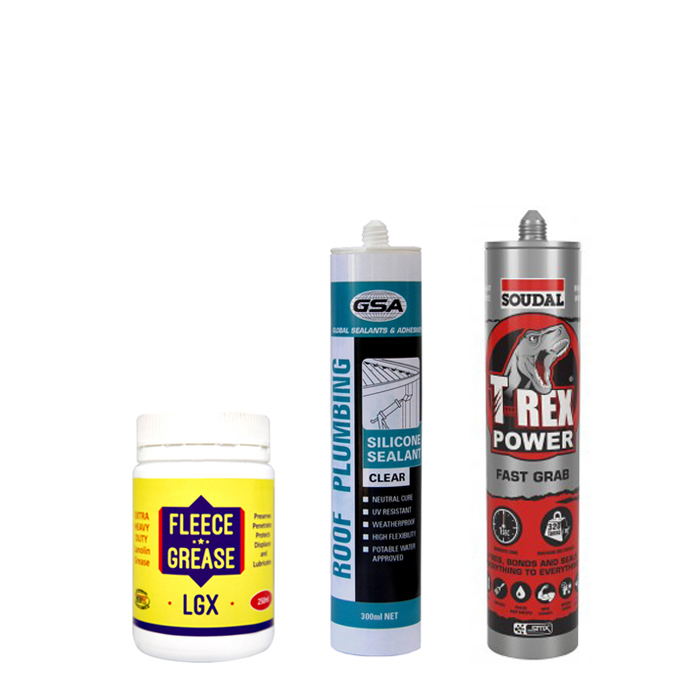
Roof & Gutter Silicone - Soudal and Bremick acetic-cure roof and gutter silicone in Translucent / Clear and grey, formulated for downpipe, gutter join and exterior penetration sealing. 290ml / 310ml cartridges.
Gap Filler - Soudal acrylic gap fillers - White Fill & Paint, White All Weather Flex - for cornice, skirting, joinery gaps. Paint-over after 24-hour cure.
As Strong As Nails - Soudal high-strength panel adhesive for plywood, MDF, cement-sheet and timber bonding without fasteners. 300ml cartridges.
SMX50 Seal & Stick - Soudal SMX50 MS polymer sealant-adhesive in Black and White - cladding, panel and trim bonding. Paintable after cure, weather-rated.
T-Rex Adhesive Sealant - Soudal T-Rex SMX polymer sealant-adhesive - the heavy-duty grade. Jet Black, Steel Grey and colour-matched options for structural panel bonding, marine and trade work.
Surface Activator - Soudal Surface Activator - prep solvent for non-porous substrates (glass, ABS, PVC, metal). Required before sealant or adhesive bond to non-porous surfaces. 500ml tin.
Threadlocking | Loctite - Ultraloc anaerobic threadlocking compounds in low / medium / high strength - the Loctite-equivalent range. 10ml and 50ml bottles. Anti-vibration fastener security.
Need help choosing the right grade or size? Our Technical PDF's Library has specification guides and technical charts. Prices include GST and free standard delivery anywhere in Australia.
FREQUENTLY ASKED QUESTIONS
What's the difference between acetic-cure and neutral-cure silicone?
Acetic-cure silicone releases acetic acid during cure (the vinegar smell) - cheap, fast-curing and the workshop default for glass, ceramic and tile. Neutral-cure silicone emits no acid - required for sealing onto marble, granite, limestone, copper or zinc where acetic acid would etch or stain the substrate. If the silicone will contact mortar or stone, specify neutral-cure.
Which Loctite-equivalent strength do I use on a structural M16 bolt?
Medium strength (blue, Ultraloc 243 equivalent) is the workshop default for most structural assembly - locks the fastener against vibration but can still be broken loose with hand tools for service. High strength (red, Ultraloc 271 equivalent) is for permanent assembly that should never need disassembly - requires heat (200°C+) to break loose. Low strength (purple) is for small fasteners and adjustable assemblies.
Do I need to clean a thread before applying threadlocker?
Yes - threadlocker cures only in clean metal contact. Remove oil, grease, dust and old threadlocker residue with a degreaser before applying fresh compound. Galvanised, zinc-plated or stainless threads cure threadlocker more slowly than bright steel - the surface plating reduces the catalytic effect. The bottle's full-cure time is for clean carbon steel; allow longer cure on plated or stainless fasteners.
When do I need anti-seize compound on a fastener?
On stainless-on-stainless thread engagement (anti-galling), on exhaust and high-temperature fasteners (200°C+), on saltwater or chemical-exposure fasteners that won't be serviced for years, and on threads that need to break loose easily after long service (suspension bolts, brake hardware). Nickel-based is the all-purpose anti-seize; copper for high-temperature; graphite for general workshop work.
What's the difference between SMX50, T-Rex and standard silicone?
Standard silicone is a sealant only - it seals gaps but doesn't carry structural load. SMX50 and T-Rex are MS (Modified Silane) polymers - they're sealant-adhesive hybrids that both seal AND carry load. T-Rex is the higher-grade structural version; SMX50 is the general-purpose grade. Both paintable after cure and bond to substrates silicone won't (treated timber, ABS, polycarbonate).
Can I use bathroom silicone outside?
For sheltered exterior use yes; for direct UV exposure no. Bathroom & Kitchen silicone is formulated for wet-area mould resistance, not for UV-exposed exterior weathering. For roofing, gutters and exposed exterior penetrations, use Roof & Gutter silicone - it carries the UV stabilisers and the formulation suited to direct weather exposure.
How long does a sealant or adhesive cartridge last on the shelf?
Unopened silicone and SMX50 cartridges have a 12-24 month shelf life in cool, dry storage. Threadlockers and instant adhesives have 6-12 months once opened (the moisture trace in the bottle starts the slow cure). Always check the date code on the cartridge end. Past-date sealants may still apply but won't reach full cure strength.
What's the right surface prep for an SMX50 or T-Rex bond?
Clean, dry, dust-free surface. For non-porous substrates (glass, metal, ABS, polycarbonate, polished concrete), apply Soudal Surface Activator first - the prep solvent etches the surface micro-roughness so the adhesive can bond. Porous substrates (timber, mortar, brick, fibre-cement) bond directly without activator.
Does anti-seize affect fastener torque values?
Yes, slightly - the lubricant in anti-seize reduces friction at the thread, so the bolt reaches its specified preload at a lower torque reading. Most published torque values assume clean dry threads. When applying anti-seize, reduce the torque target by ~15-20% to compensate, OR torque to the published value if the bolt is non-critical and over-tightening is acceptable.
Can threadlocker be removed once cured?
Yes. Medium-strength (blue) breaks loose with standard hand tool torque - sometimes with a slight pop as the cured film cracks. High-strength (red) needs heat - apply 200-260°C with a torch or heat gun to soften the cured polymer, then break loose. After disassembly, scrape or wire-brush the old residue from both threads before re-applying fresh compound.
Which silicone do I use on copper or zinc downpipes?
Neutral-cure silicone, not acetic-cure. The acetic acid released by curing acetic-cure silicone will etch copper and zinc surfaces over time. Neutral-cure Roof & Gutter silicone is the right choice. The product label will state 'neutral cure' clearly.
Where do I find application data sheets and full strength specs?
Soudal, Molytec and Ultraloc publish TDS (Technical Data Sheets) per product with full cure time, strength and substrate compatibility data. Links to the per-SKU TDS are on each sub-cat page. The Technical PDF's Library library carries an overview chart by application.
WHY AUSTRALIA TRUSTS BOLT & NUT
With 15+ years selling fasteners online from Brisbane, we hold over 25,000 stock lines and 200 million pieces - 98.75% of online orders placed before 1pm leave same day. Save more as you buy more - we offer up to 13 price breaks plus 3 spend-tier discounts. Read our customer reviews or get in touch if you need help picking the right silicone, sealant or adhesive.
-
Anti-Seize -
Chemical Anchoring -
Cutting Compound -
Glue & Adhesive -
Grease -
Pipe & Gasket -
Silicone & Sealants -
Threadlocking | Loctite
-
Free shipping
In stock
Bright White T-Rex SMX Polymer Sealant Adhesive Soudal 290ml Cartridge 121968As low as $15.300 each -
Free shipping
In stock
Concrete Grey SMX50 Seal & Stick Polymer Sealant Adhesive Soudal 290ml Cartridge 128737As low as $12.750 each -
Free shipping
In stock
Black SMX50 Seal & Stick Polymer Sealant Adhesive Soudal 290ml Cartridge 128736As low as $12.750 each -
Free shipping
In stock
White SMX50 Seal & Stick Polymer Sealant Adhesive Soudal 290ml Cartridge 128738As low as $12.750 each -
Free shipping
In stock
Concrete Grey SMX50 Seal & Stick Polymer Sealant Adhesive Soudal 600ml Sausage 124542As low as $12.750 each -
Free shipping
In stock
Black SMX50 Seal & Stick Polymer Sealant Adhesive Soudal 600ml Sausage 124606As low as $12.750 each -
Free shipping
In stock
White SMX50 Seal & Stick Polymer Sealant Adhesive Soudal 600ml Sausage 124617As low as $12.750 each -
Free shipping
In stock
Brilliant White / White Haven All Purpose Silicone Soudal 300ml Cartridge 121661As low as $11.050 each -
Free shipping
In stock
290 and 300ml Premium Heavy Duty Dripless Skeleton Gun to suit Silicone Cartridges SoudalAs low as $30.600 each
Silicones, adhesives, threadlockers, anti-seize, greases and cutting compounds - Soudal silicones, Ultraloc Loctite-equivalent threadlockers, Molytec anti-seize. The chemistry side of fastener assembly.